Architecture

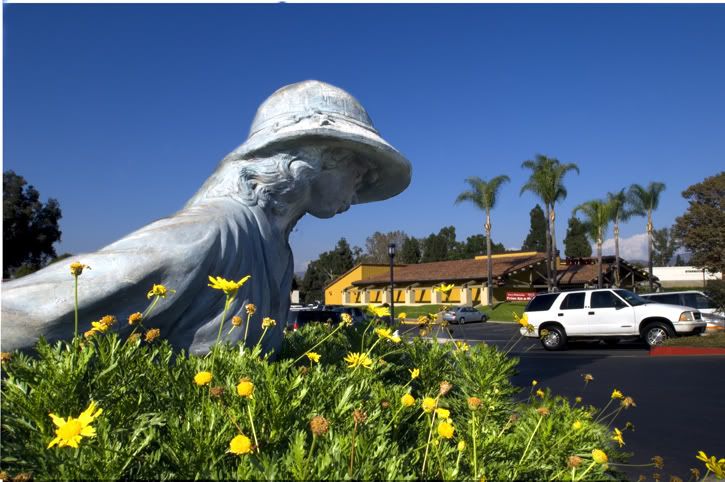
Forty Seven Years Ago

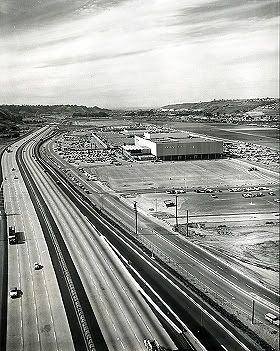
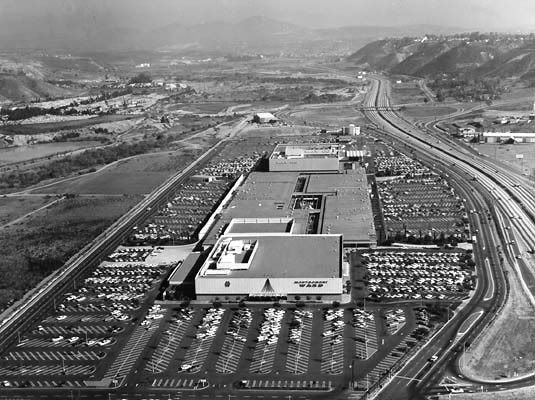
It was forty seven years ago pastoral Mission Valley was changed forever.  The city at large began to change as well.  Excitement over three new malls–College Grove, Grossmont Center, and Mission Valley–resulted in a decline for downtown department stores and merchants.  El Cajon Boulevard also lost its prestige as a shopping and business corridor as people flocked to the three new shopping centers.

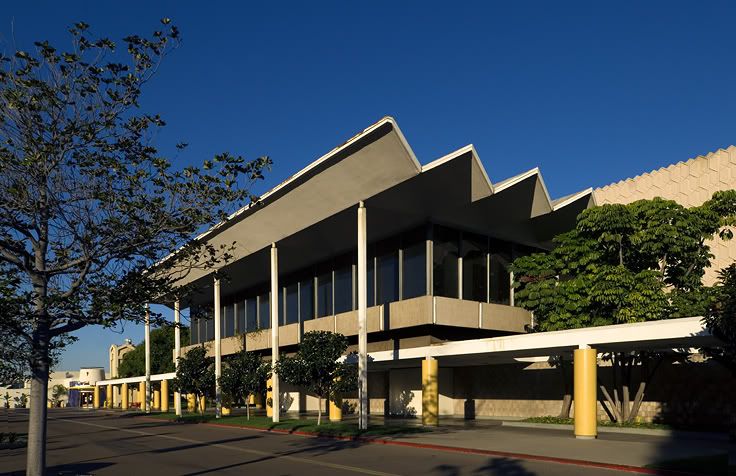
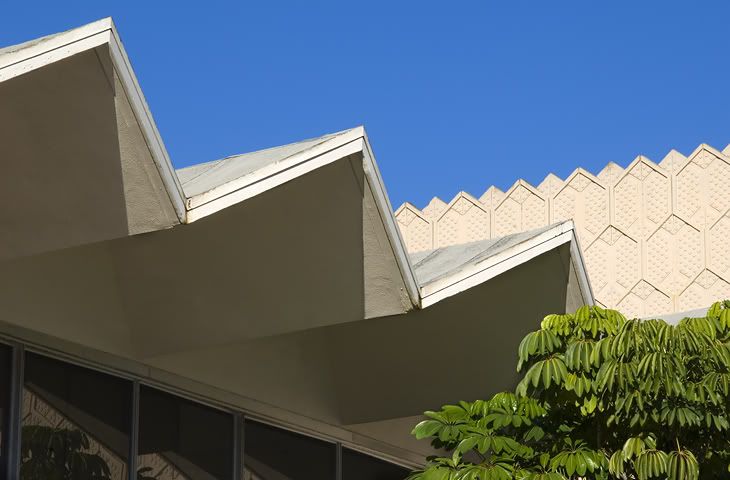
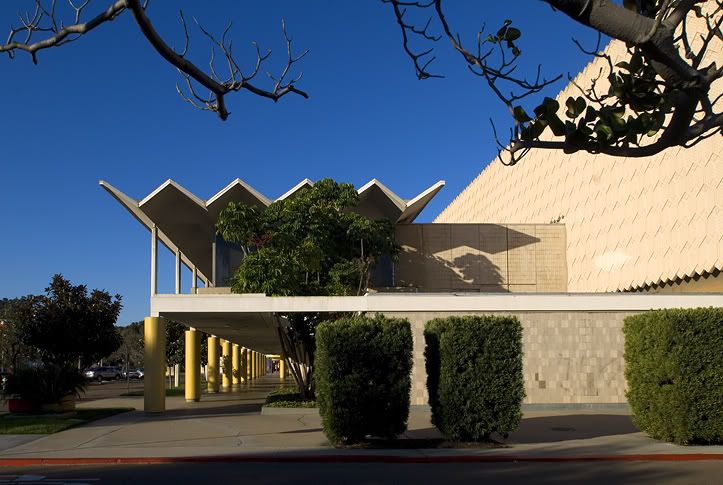
The May Company became the premiere department store in San Diego when it opened with the Mission Valley Shopping Center in 1961.  It was designed by William S. Lewis.

Its most attractive feature was the restaurant. One could luncheon and enjoy a panoramic view.  I remember it being a pretty reliable place to get a burger, sandwich or salad.

But department store restaurants fell out of favor.  This unique space is used for nothing more than storage today.
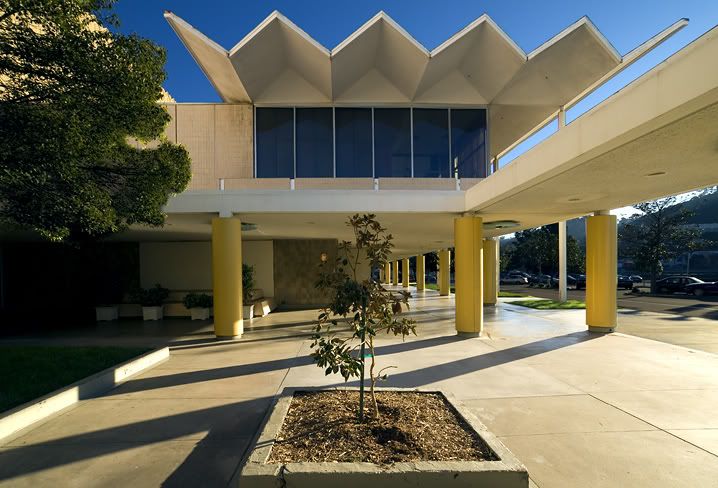
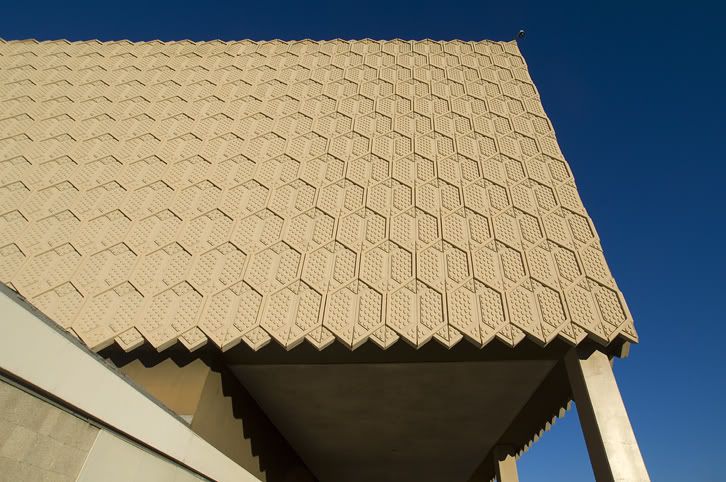
The serrated roof line of the main building complements the restaurant roof line perfectly.  I remember the main building being a yellowish gold color.  It seems those colors have also fallen out of favor nowadays.

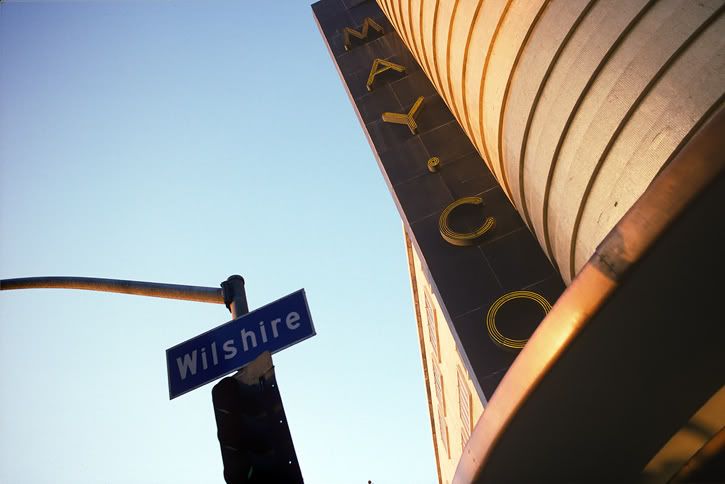
The May Company on Wilshire and Fairfax in Los Angeles prominently displays gold.

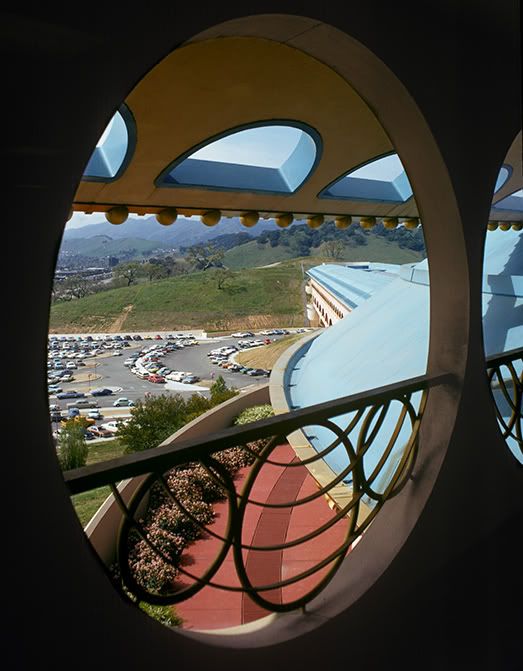
Frank Lloyd Wright originally envisioned the Marin County Civic Center with a Gold color roof.   Blue won out, however the roof trim ornament is goldish, as are the portal rails.

The lack luster beige probably came about when May Co and Robinsions merged.  Now it is Macy’s.

One wonders if this element will survive future expansion plans for the mall.  Adding a second deck is proposed.  I won’t be surprised if all existing mid century design aspects are erased and replaced with the “anywhere in America” look.  I’m not sure many people remember this as a restaurant.  It is most likely just viewed as an inadequate storage space.  Would be nice though if the new plans solved their expansion needs and preserved the old cafe and brought it back.

Dan Soderberg Photography

“Blighted” Community

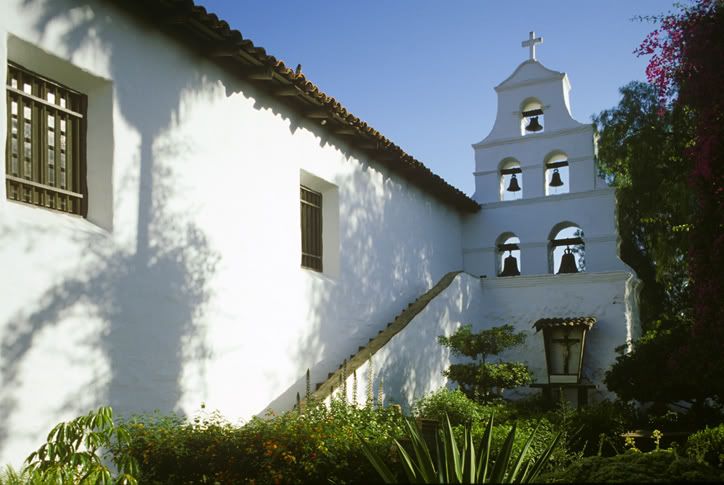
Grantville in San Diego is one of California’s oldest communities.  Mission De Alcala is there.

Named after Ulysses S. Grant in 1887, the area was envisioned as an enclave for retired Civil War veterans.

A boom and bust cycle prevented realization of that plan.  But the area saw extensive agriculture and dairy farming through the turn of the century.

Grantville residents in 1913 formed a Mission Restoration Committee and helped spearhead the effort to preserve the ruins at Mission De Alcala.
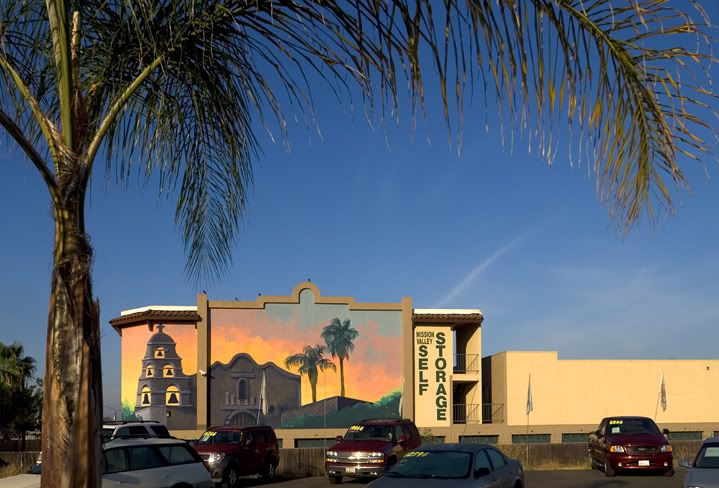
Today Grantville is a thriving middle class community ideally suited for small business owners.
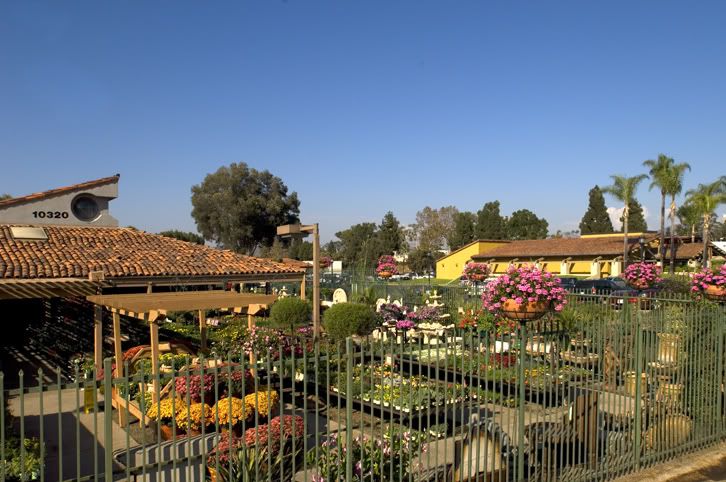
But to the dismay of Grantville residents and business owners the city of San Diego has declared Grantville as “Blight.”Twenty-two year Grantville resident Steve Rhodes said with a hint of sarcasm, “If you look around the area here, you can see how blighted Grantville is.”
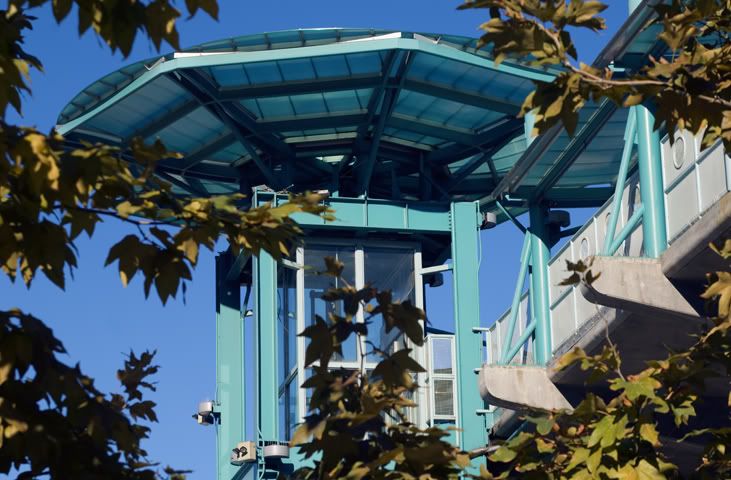
Grantville Trolley Station

At the center of the Grantville discussion is a potential  $610.4 million to be gathered from property taxes between 2005 and 2050.

Whether Grantville deserves the “blight” designation or not, it is the trigger required to release those funds for redevelopment.
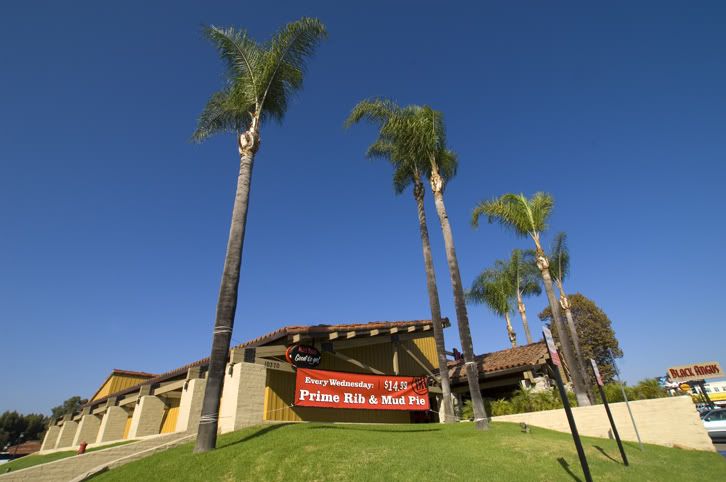
When you’re in Grantville you have to ask “what were ‘they’ thinking calling this blight?  The situation brings to mind Justice Potter in 1964 trying to define pornography, “I know it when I see it.”
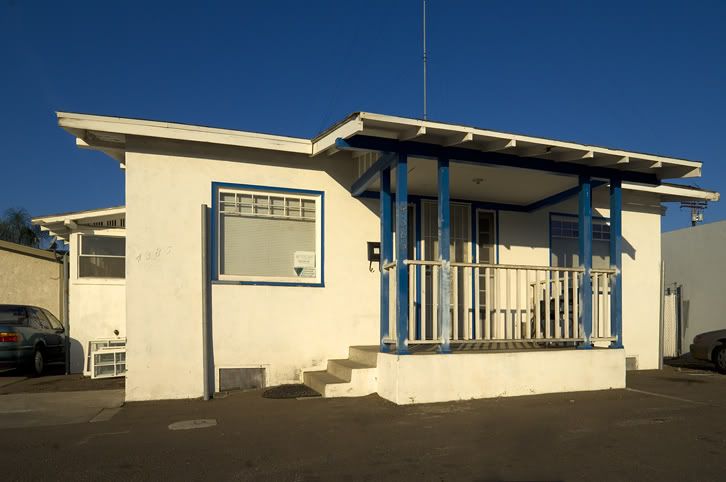
Landscape Contractor Dave Suda operates his business on 1/3 acre attached to this modest 1920’s structure.
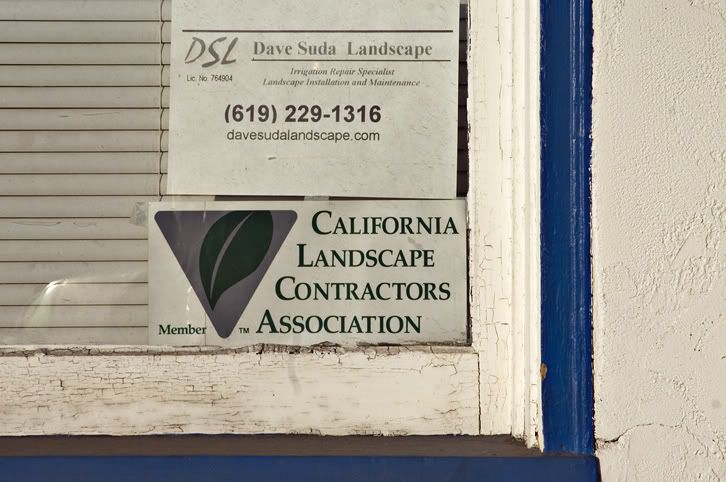
It is the kind of business that will get pushed out of Grantville upon redevelopment.  Leases and mortgages will go up.  Nor will the type of space needed for a landscaper likely be imagined or considered by developers.  Not enough return for their investment dollar when they can put ten or twenty condos in the same space.

A place with room to keep top soils, planters, and equipment.

“That my fine-tuned, well run, shop is ‘blight’ kind of amazes me,” said Suda.
The blight designation didn’t seem justified by the County of San Diego either.  They took the City of San Diego to court over the matter.
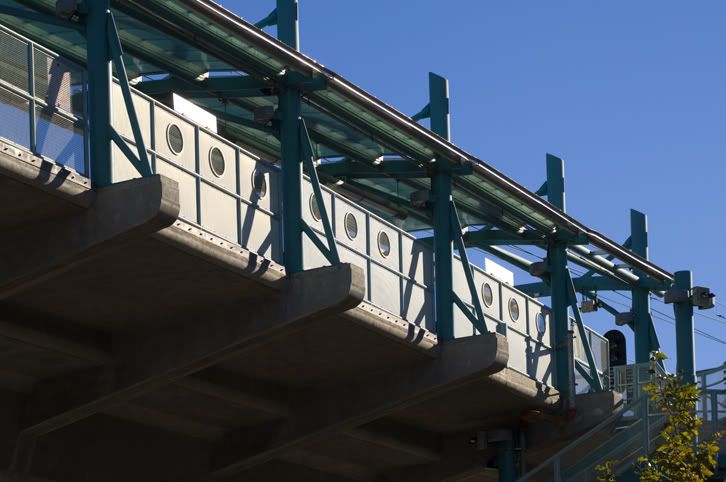
Grantville Trolley Station

To settle, San Diego City diverted $31.4 million dollars to San Diego County.  Many question the legality of transferring Grantville money to another community.
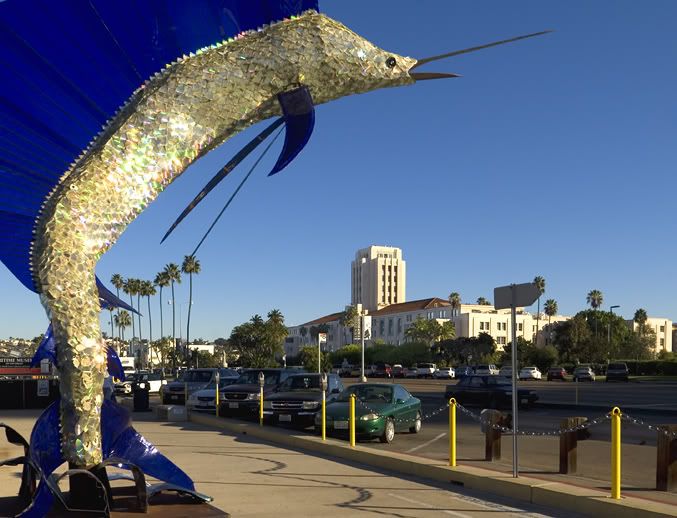
The law says for redevelopment money from a community to be used outside that community, it must demonstrate the benefits to them.
Grantville residents are scratching their heads over this one. The money ends up here at the County Administration Building for parking lot improvements.
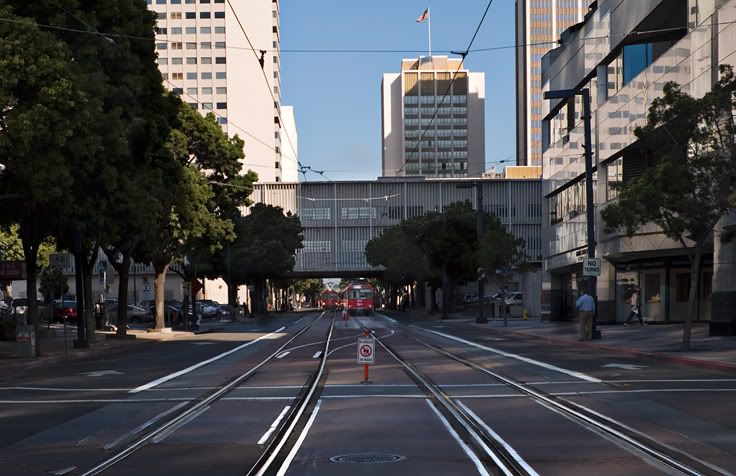
But since this would certainly seem illegal, decision makers came up with a scheme.  The Center City Development Corporation will cover the $34.1 million dollars for parking improvements at the County Administration Building.  Then the $34.1 million dollars out of Grantville will go to downtown trolley line improvements.  Putting in one pocket then taking out of another.  Moving shells around.
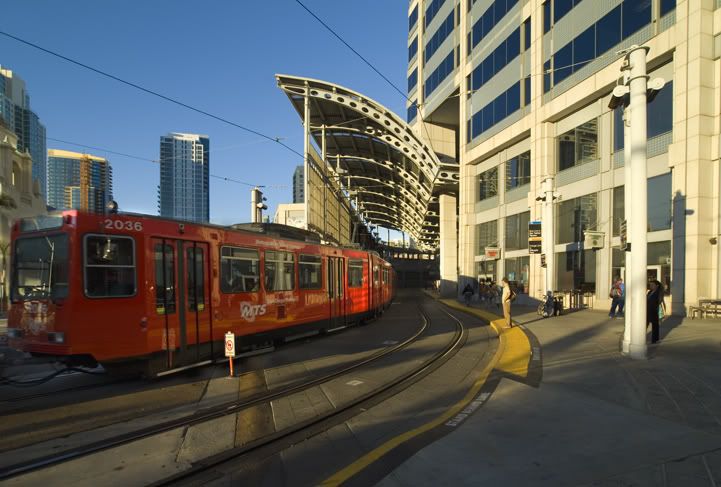
It is argued that the steel tracks link Grantville to Downtown.  And that spending Grantville money on the downtown trolley-line corridor will encourage Grantville residents to use the trolley more.

This practice of engaging in financial transactions in order to conceal the identity, source, and/or destination of money seems all too common today.  It is perfectly clear the current failures of our financial institutions, large businesses and governments are linked with such “creative thinking.”
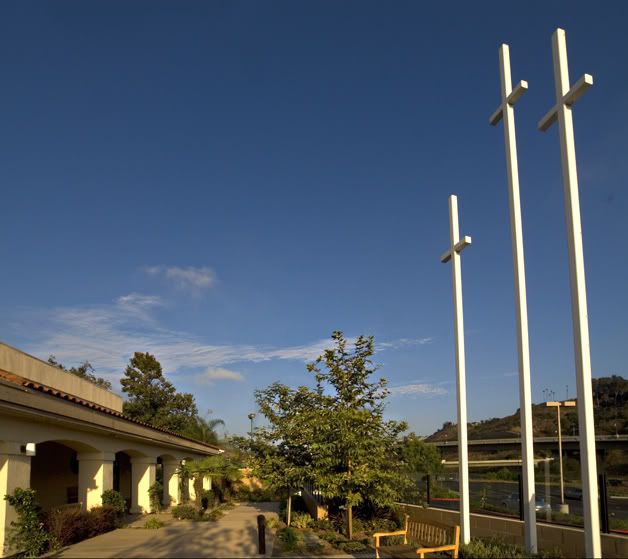
The redevelopment zone also conflicts with the San Diego River Master Plan, which has priority.  That is yet another legal dimension in this tangled affair.
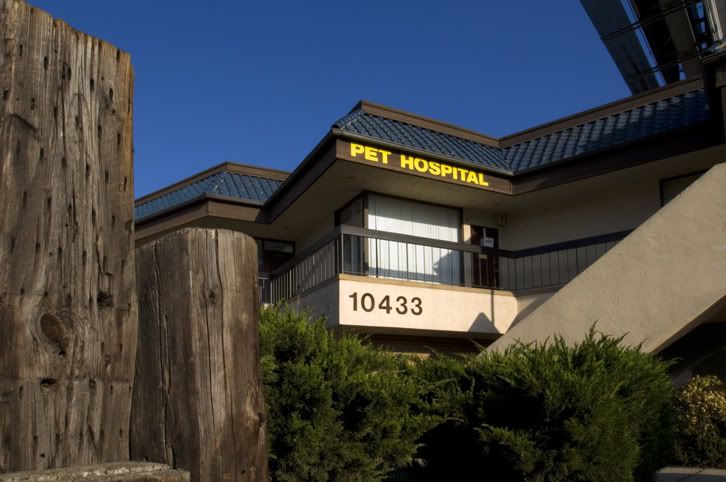
Another “blight” business owner is Brian Peterson of the Friars Road Pet Hospital.  He is fighting to take back the community with a group called the

Grantville Action Group.  They are suing the city over this diversion of money out of their community.

I urge everyone who is concerned about highly questionable redevelopment decisions and the abuse of eminent domain to support the Grantville Action

Group with your donation.  Their website is www.grantvilleactiongroup.com

My video 

Architecture
Squeak, Squeak, Squeak.

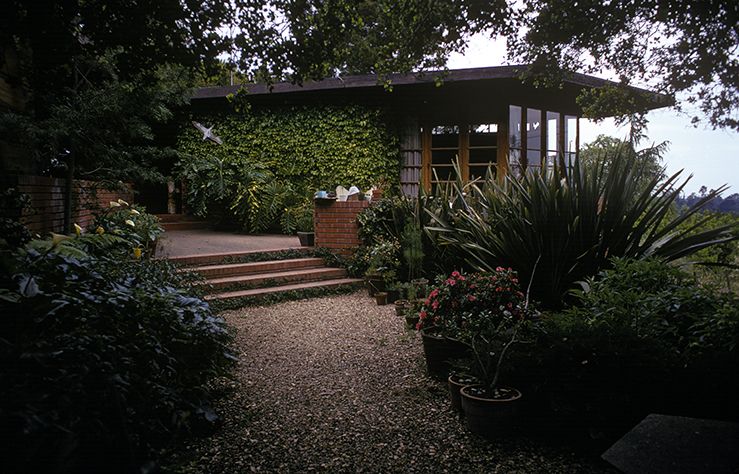
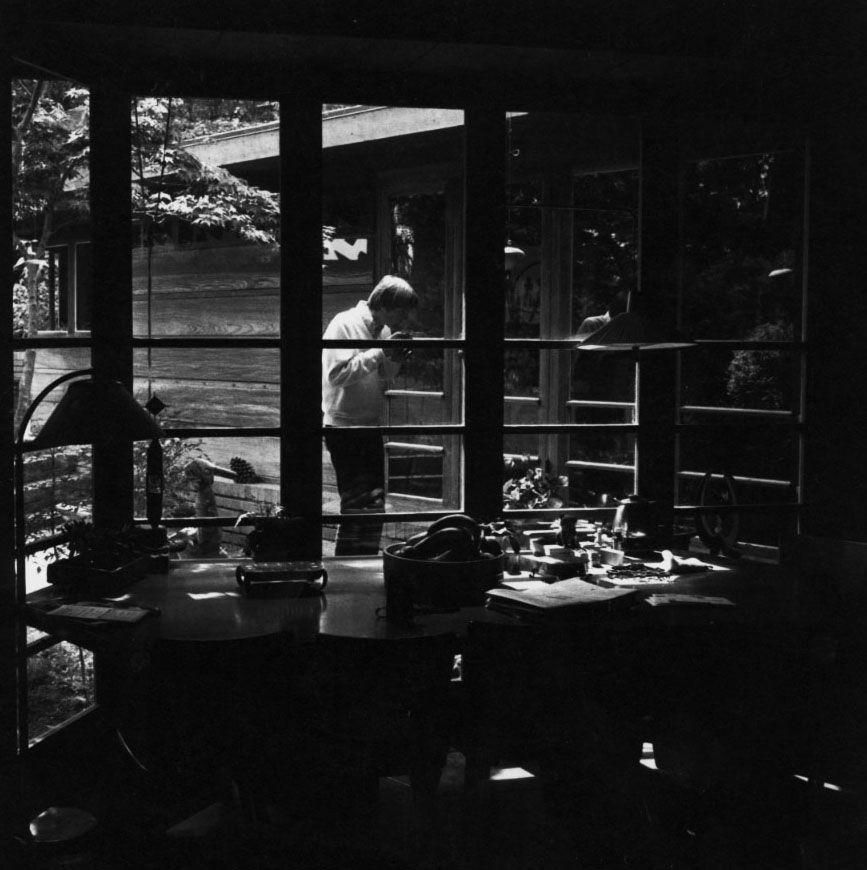
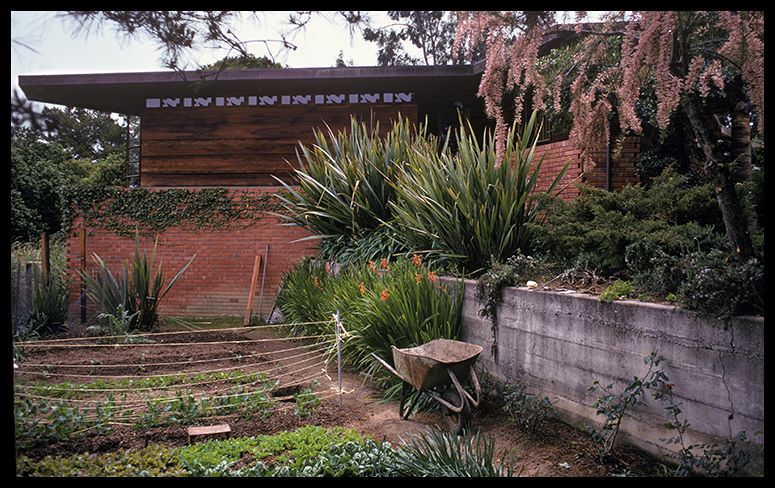
I surveyed a number of Northern California Frank Lloyd Wright structures in April of 1971. One of my favorites is the Bazett House in Hillsborough, 1939. It is one of Wright’s finest “Usonian” houses. This is a category of house characterized by reduced building cost via simplified design.

Wright’s Usonia doctrine includes flat roofs. “Visible roofs are expensive and unnecessary.”

Carport instead of garage. Slab foundation–no basement. Simplified plumbing. Radiant heating.

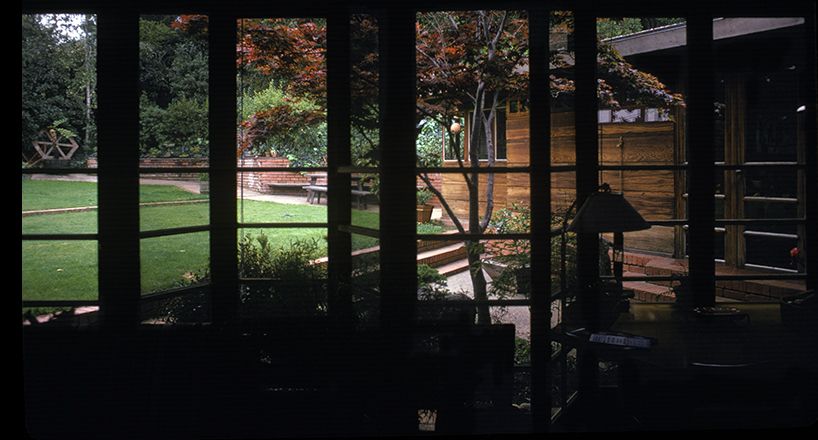
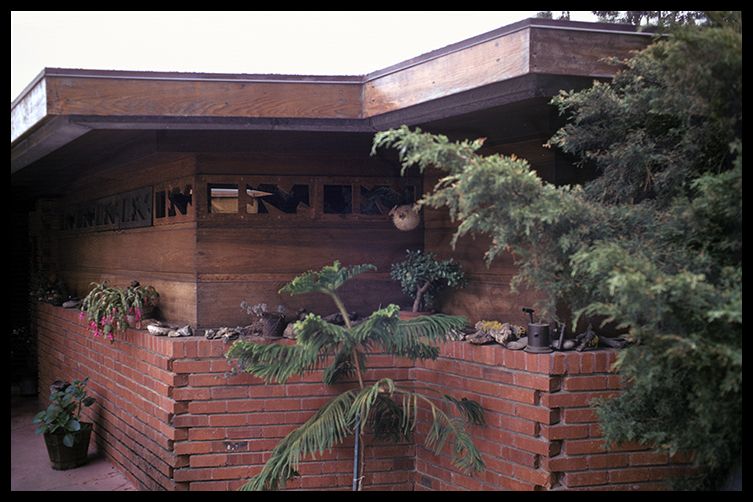
This house was designed with a hexagonal grid or layout. Note the playful pattern this creates with the glass living room wall. Wright loved blending where exterior space ends and interior space begins. It is a common trait for the Usonian houses to be wide open toward the garden, but closed and private on the side facing the street. That closed side was often butted up along the street to maximize garden space and vista at the open side.

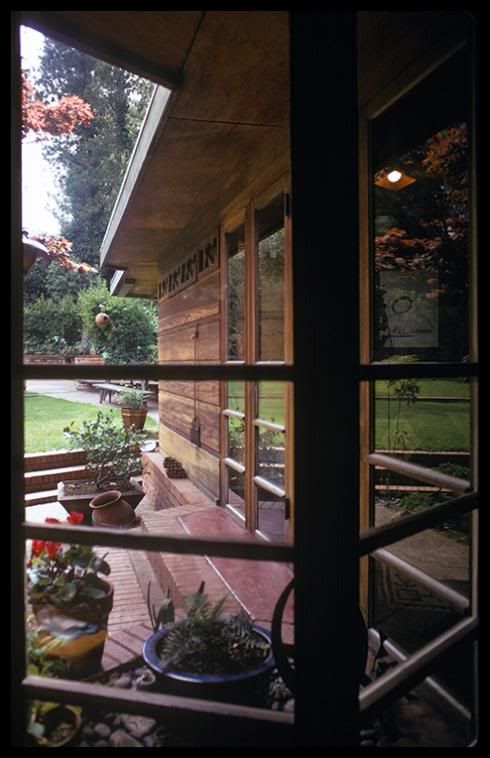
Wright utilized a cost efficient wall system known as “Board and Batton.”

“It is possible to build the inside and outside of the house in one operation,” Said Wright.
The system consisted of a plywood core with a moisture-proof membrane. Finished horizontal bands of wood were placed over the core inside and out, secured by screws.

Wright’s Usonian houses were not large. The most generous amount of space was devoted to the living area. The kitchen was galley like. Modest bathrooms. The Bazett House is 1,480 square feet.

The building was over budget. $7,000 was the allocation but projected costs were nearly $12,000. Yet the Bazetts by all accounts were enthusiastic owners.

Many of Wright’s over runs have been highlighted and widely publicized.

However Architect Bob Green, once an apprentice to Wright, offers some perspective on the subject.

“..It was said that all of the buildings of Frank Lloyd Wright leaked, and all were over budget. Not true! He did many houses for teachers, college professors and people not highly paid and who did not have the money for the building to be much over budget. And as far as leaking roofs: maintenance must be done on buildings–as well as cars–or in time neither will not work very well.”


Sadly there was trauma for the Bazetts. The birth of a still born child. After only two years of residence, they moved out and lived separate lives.
The residents I spoke with were the second owners of this property. They were kind enough to talk about their life in a Frank Lloyd Wright house and allow me to take these photographs.
They said living in this house is a perpetual source of fascination. Every day brings some new light, pattern, glow, shadow or reflection they hadn’t seen before. From morning to night. From Winter to Summer. “The house always delights us with surprise and wonder. It is uplifting to live in this beautiful space. We’re as thrilled now as the day we moved in.”

The closed side of the house facing the street. The purpose of the patterned cut out window design is mainly decorative and for interior lighting effect.

The owner’s story I enjoyed most was about waking up early one Sunday morning to the sound of “squeak, squeak, squeak.” They went to look and viewed the unmistakable low brim hat, the flowing cape, walking cane hooked over an arm, and dapper attire of non other than Frank Lloyd Wright as he stood outside cleaning windows with his handkerchief.

Many a Wright owner I’ve spoken with had similar stories. Wright showing up with an object of art and knowing exactly where he wanted it placed. Wright coming in an moving furniture around, arranging things.
He liked to say his favorite design was “always the next.” It seems these unexpected appearances indicates he also he had old favorites as well.

Dan Soderberg Photography

The California


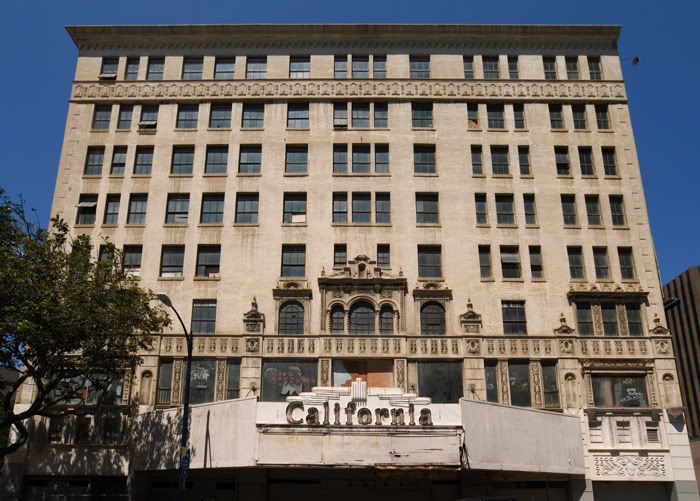
Two old grand movie palaces survive in San Diego. Happily the Balboa in Gaslamp has been returned to her former glory after decades arduous effort to gain preservation. Sadly The California sits in utter dilapidation. In the words of an urban poet: “She’s a wounded survivor, limping but displaying her teeth.”

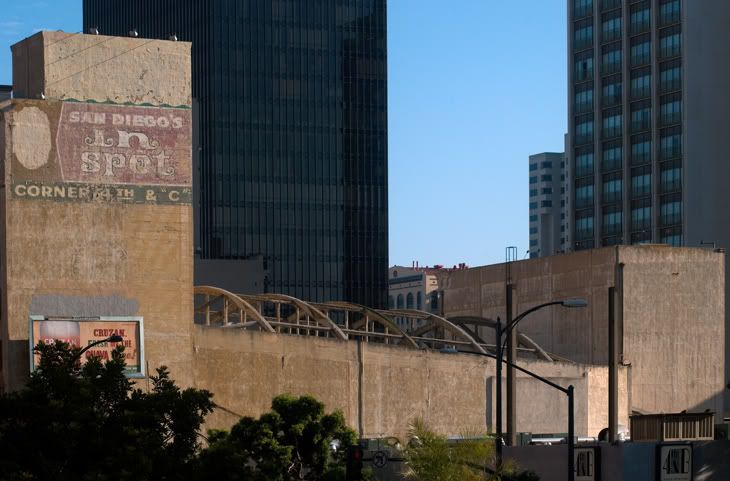
Showing its teeth, or from this view, showing its bones–the bow string truss. Likely the truss wasn’t visible before an adjacent building was razed.

The “In Spot” ad is painted on the theatre entrance and office tower along Fourth Avenue. That portion is nine stories high. The auditorum stands nearly five stories high and contains 2,200 seats. The proscenium area facing third avenue is six stories high.

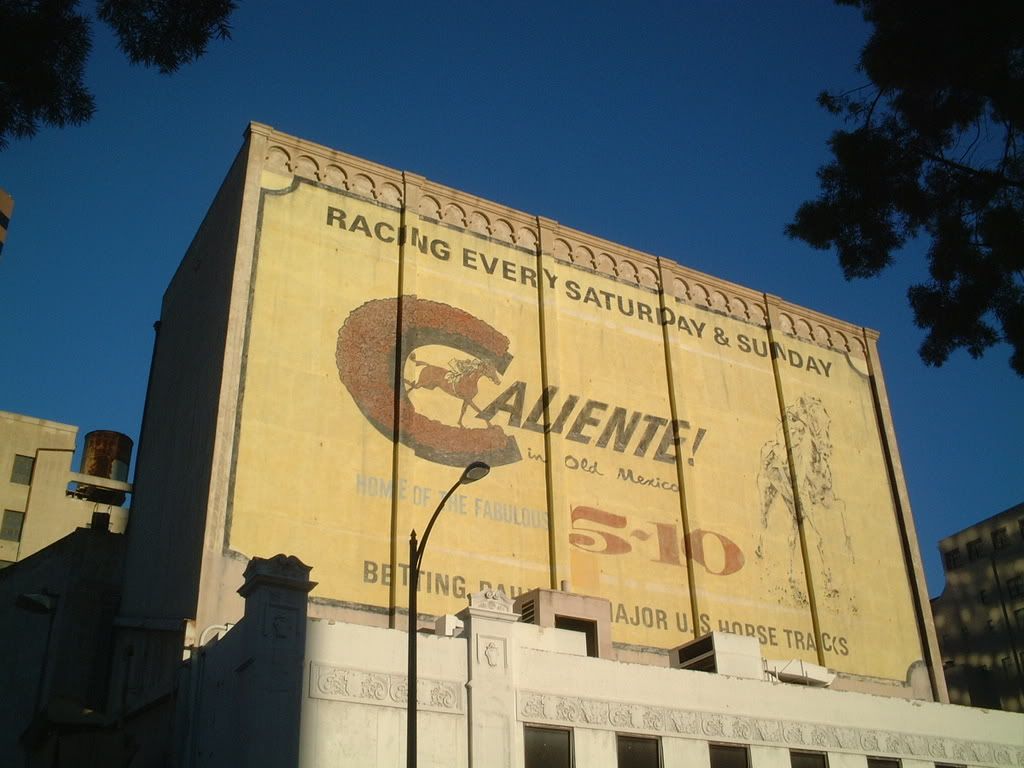
I don’t recall a time in my life when this Caliente billboard wasn’t on the back side of the proscenium structure. Certainly the movie palace alone represents a by gone era. But so do these advertisements, the “In Spot,” and the Caliente horse racing ads. There was a dog racing ad too.

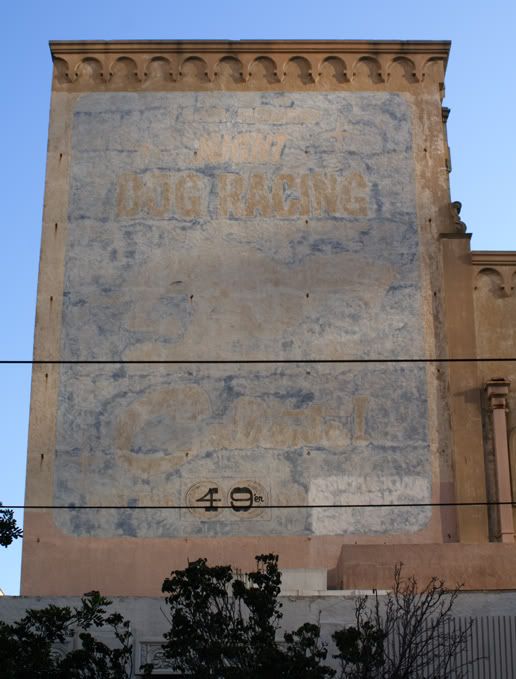
The Caliente dog racing advertisement was painted over. However, a bit still shows through. The race dogs used to chase “‘Pepito,’ the mechanical bunny.” The sport fell out of favor after revelations of inhumane treatment received a lot of press.

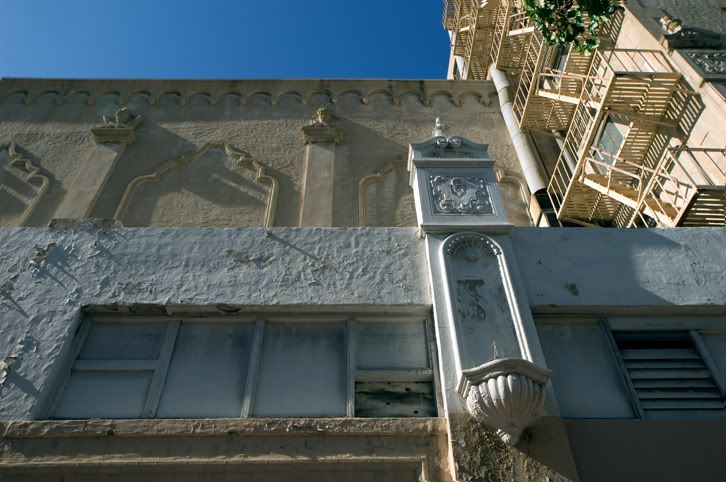
Details of the Spanish Colonial Revival ornament.

Upon opening in 1927 the California was celebrated as “the cathedral of the motion picture” and “an enduring contribution to the artistic beauty of the entire Southland”

Cracked and broken but still holding strong. Waiting for a developer with a heart, not just a lust for making a buck.

At its grand opening on April 22, 1927, the theatre presented Constance Talmadge and Antonio Moreno in “The Venus of Venice”, Fanchon and Marco’s “Book ideas.”

The movies I saw here included several James Bond pictures. I remember seeing a Mel Brooks double feature of The Producers and Blazing Saddles. The California went dark as a movie theatre in 1976.

In 1978 an arson fire destroyed the Old Globe Theater in Balboa Park. The California became the temporary Old Globe Theater during reconstruction.

The interior was decorated in gold leaf and murals. The side walls of the auditorium were inspired by a Spanish church. A huge Wurlitzer organ was also a proud asset. Things were looking up for the California in 1988. A lot of fixing up went on.

It was about that time I saw a concert there. English Beat was the band.

The California’s run as a concert venue was short lived. By 1990 it was slated for demolition. However, the wrecking ball has yet to arrive.

In the mean time it suffers demolition by neglect. Each passing year makes it more impossible for the “beast” to be a beauty ever again. But we can hope for a reverse of fortune.
Historic Photos

California Theatre

“Open All Night” The California in the 1940s

Balcony Staircase

1929

Beatlemania

Reference Source, San Diego Historical Society

Dan Soderberg Photography

Cinder Block Sonata

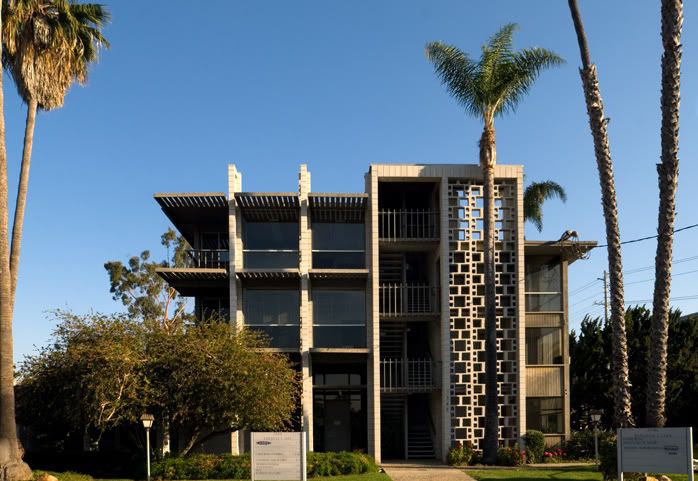
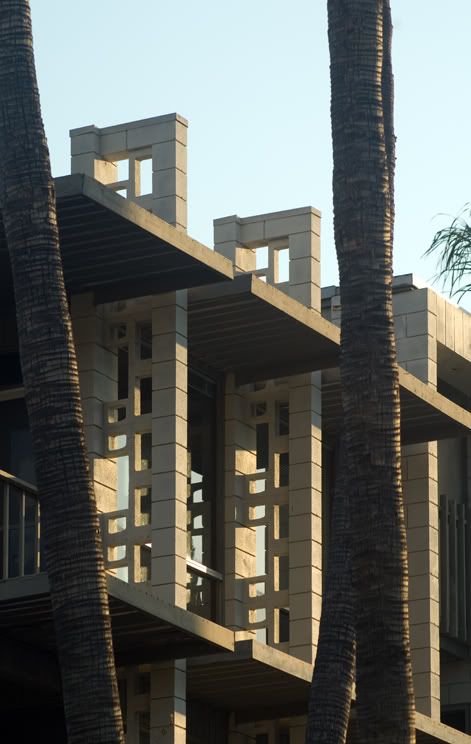
I’m not sure people knew much about Sorrento Valley while construction of interstate 5 was under way in the mid 1960s. By 1971 Sorrento Valley was known for its clusters of industrial parks. There typically isn’t much to get excited about when it comes to industrial park architecture. It is pretty much a cookie cutter genre. But a commission by renown architect Loch Crane broke that mold.

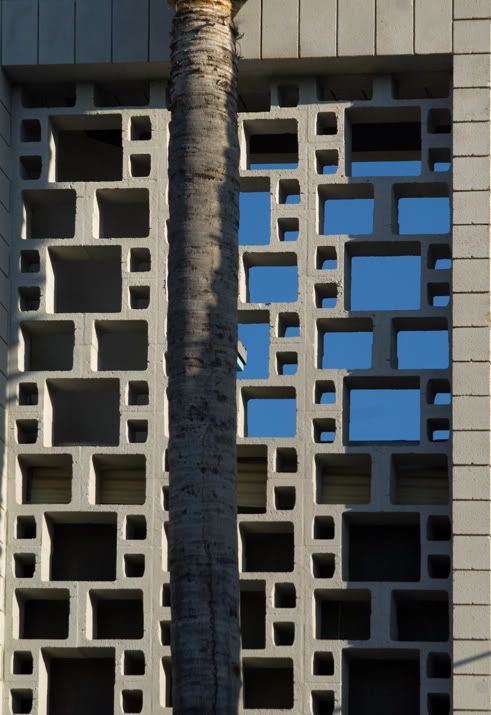
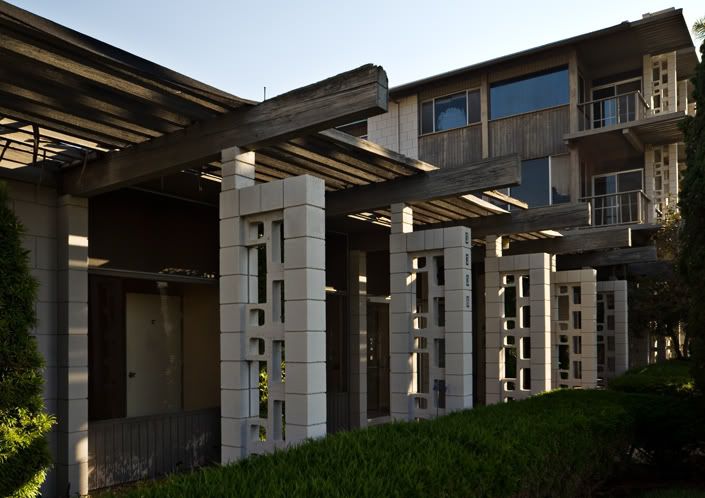
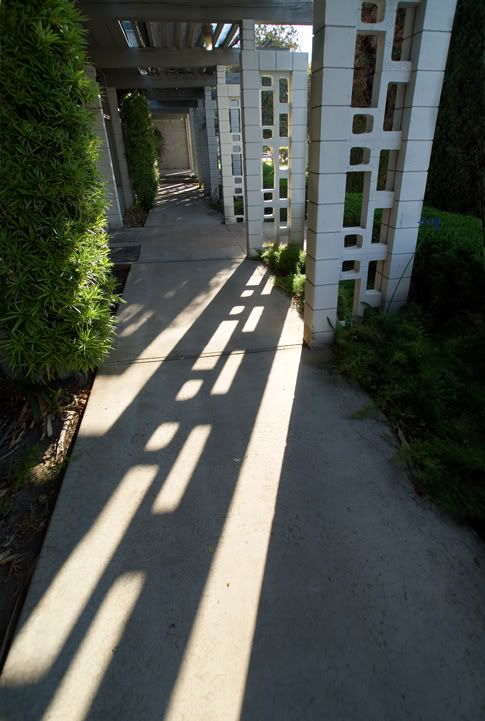
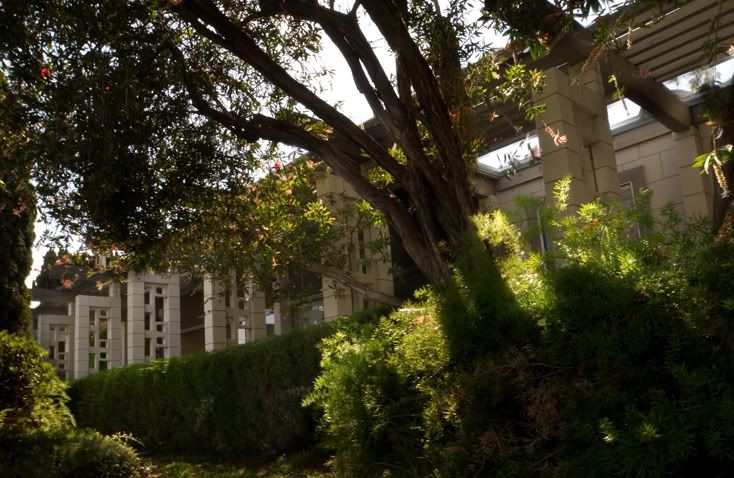
The building is industrial all the way. With exception of wood trim and siding, this is all concrete and cinder block.

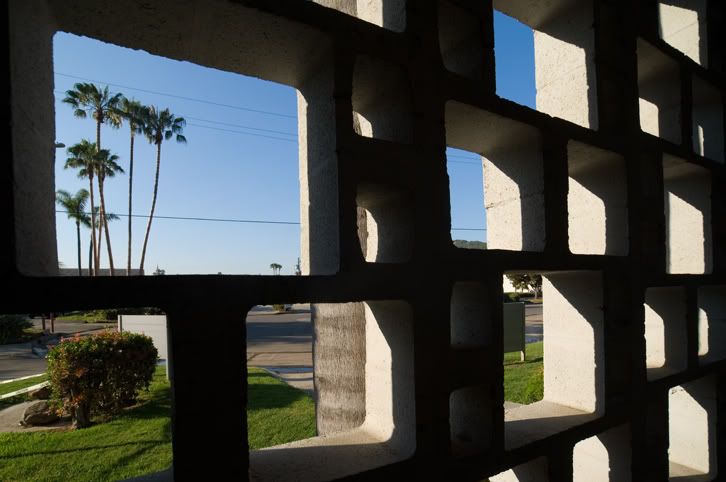
It is the playful use and arrangement of these common materials that sets it apart.

The wooden beam pergola covers the walk way lined by a cinder block colonnade.

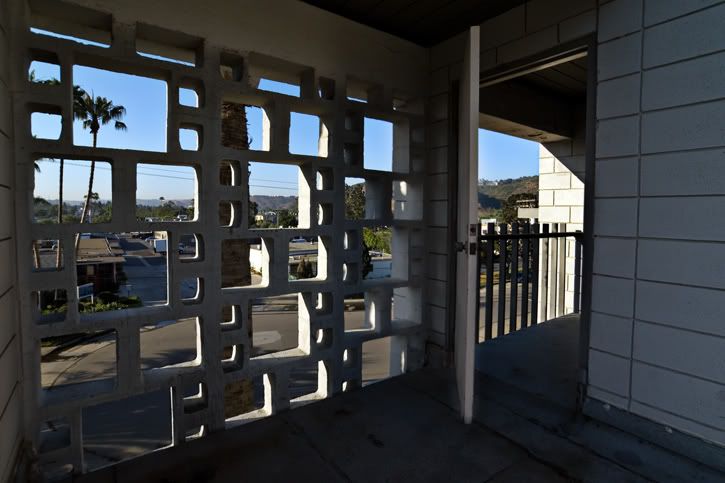
A line of offices have a filtered view through the motif.

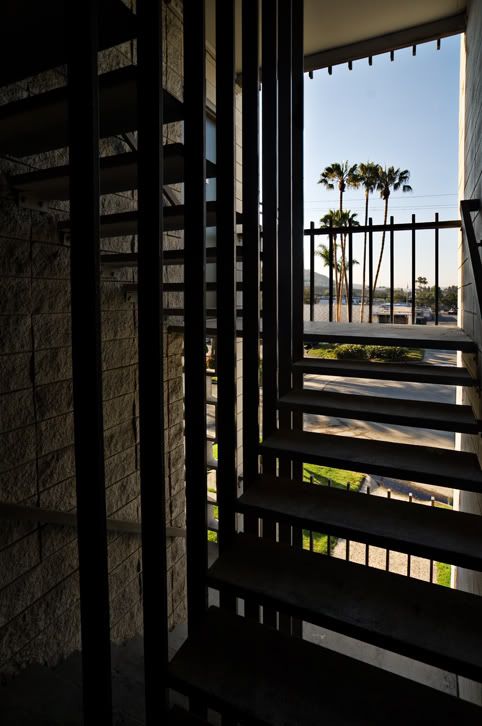
Up the staircase.

From the top floor, a view of the valley filled with buildings not nearly this clever.

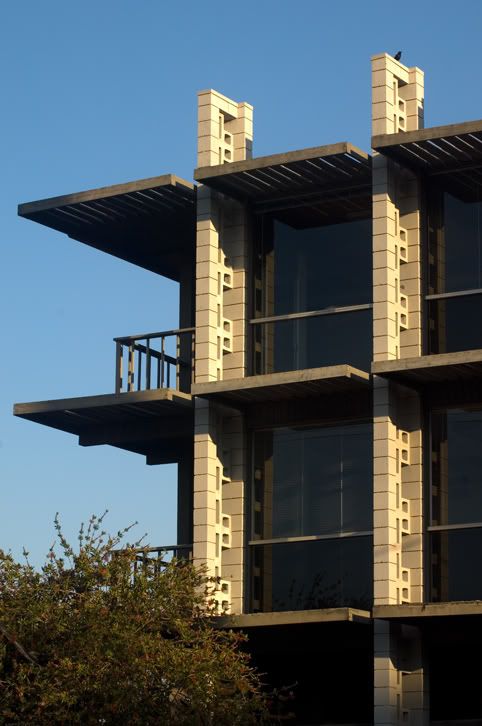
A lady who runs a catering business across the street fondly calls this “The Tower.” With exception of the lowly bird sitting atop, not a soul is at “The Tower” any more. The building is slated for demolition. The site is to be scraped for a 24 Hour Fitness facility. “Aren’t we lucky,” said the lady sarcastically.

Behind the tower an industrial portion of the complex still has tenants. I spoke with a gentleman from a company called Car Turner. They build turntables for cars, a lazy susan if you will. To turn your car around by the spin of a platter you park on. Another gentleman in the complex makes surfboards. Both guys spoke of their desire to remain in a building they appreciate and admire. “The way the sun comes through here in the morning is awesome,” they said.

This is another sad story in a book of many. Good and great architecture is looked upon far too commonly as a disposable commodity. Like a car. To be used and finally junked.
Dan Soderberg Photography

Neighborhood Cinema

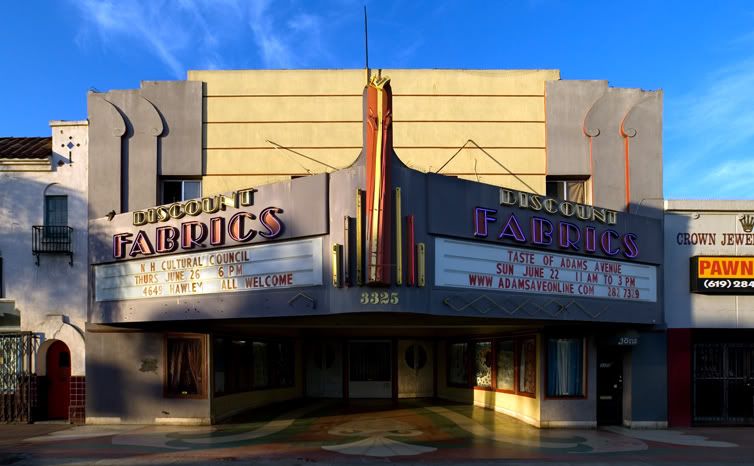
The Carteri, then Adams Avenue Theatre. (1924)

For my neighbor, Mrs. Kahan, this was the neighborhood movie theatre she enjoyed from 1947 when she first moved to Normal Heights.

“After the matinee you could catch a street car on Adams for a nickle and ride anywhere in town to find a place to eat.”

The house went black in 1962. The interior was adapted as retail space. But at least the exterior was kept mostly intact, minus the ticket booth which sat there in the middle. The terrazzo is in fairly good shape, although back in the day these received regular finish to maintain a high gloss. It is a bit dull now. And the display cases that once showed coming attraction posters are still intact. All too often display cases of converted movie theatres are boarded up or covered.  Historic Photo.

I was in Westchester recently visiting my long time friend Kenny Garrett. We walked a few blocks from his house and he showed me what used to be his neighborhood theatre, the Loyola. That neon tower stood some 60 feet high. Note the illuminated display cases. It opened on October 3, 1946. It went dark in the 1980s. The above is a historic photo from the 1970s.

Although the shell of the Loyola remains there are no remaining movie theater elements inside. It is all office space. And what is left outside is a far cry from how it used to look. Someone was in love with shot-crete or stucco. Every inch was plastered with it. Marquee, display cases and the tower.

In the historic photo notice the detailed ornament adorning the plumage rising above the marquee. There’s a discussion in the THEATRE HISTORICAL SOCIETY OF AMERICA’s 1987 annual about the genre of architecture the Loyola belongs to. They refer to it as the “Skouras style,” named after two brothers–Skouras- who managed several cinema chains. Their designer was named Carl G. Moeller. He utilized new technology and materials, namely aluminum to achieve this highly ornate decor inside and out. The result was a style landing somewhere between Art Moderne and Streamlined. The grandiose sweeping and swirling was possible because aluminum was cheap–ornamental forms of aluminum were easy to craft and mass produce. So they went hog wild with flamboyant movie house design.
All that ornamental detail is covered up. All that neon is gone.

I probably don’t need to mention the Swan motif. But I will because the venue was always matched up with films of like theme. The Loyola first ran To Kill A Mockingbird. And the run of Alfred Hitchcock’s The Birds is something people still talk about. “There were several “dead” artificial birds placed along the marquee. Most interesting and clever was the box office where two or three of the birds had been cut in half and pasted to either side of the window, each ‘head’ stuck on the inside with the ‘tail’ on the outside. Tiny ‘cracks’ were painted on the glass. This gave the appearance that the ‘birds had crashed right through!” Mike H.


The terrazzo isn’t too shabby. However I noticed at one end a few spray-painted lines. The kind you see just before a jack hammer shows up.

The Loyola sat 1,234 people. It boasted an army of uniformed ushers and usherettes. There was lots of red velvet. Fancy bathrooms. Fancy snackbar. Stadium seating in back. This show had it all.

Dan Soderberg Photography

Neighborhood Library

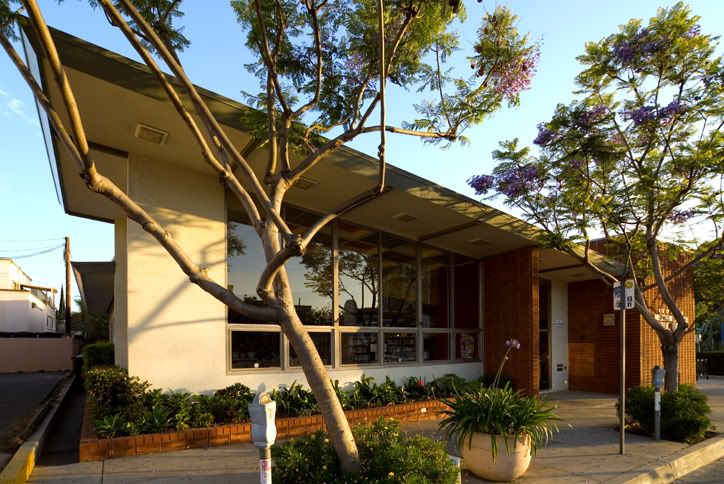
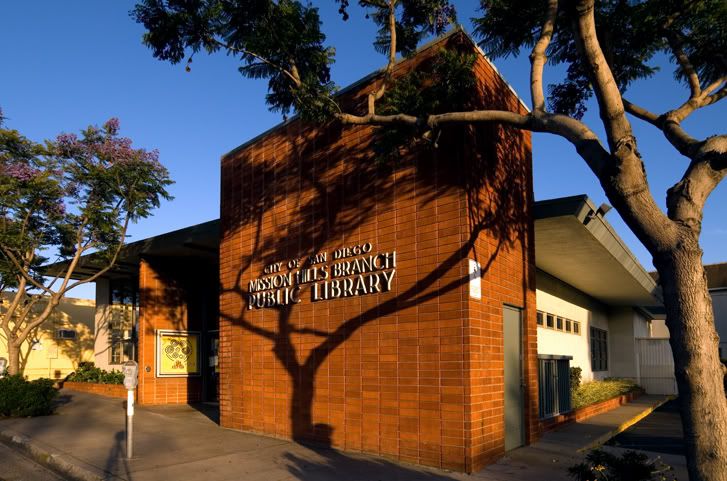
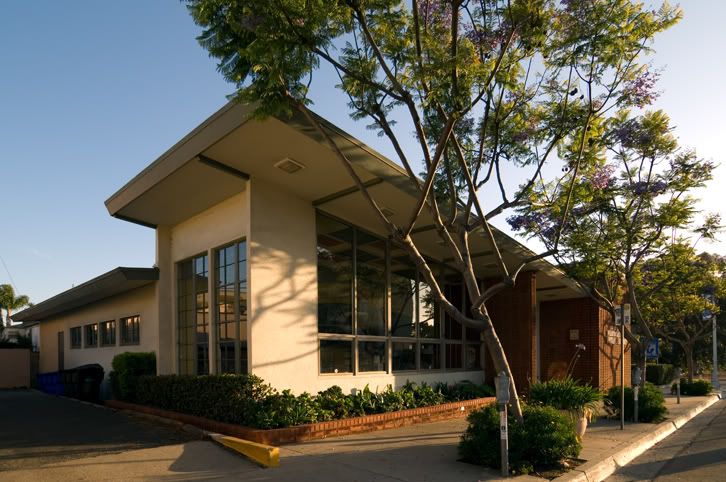
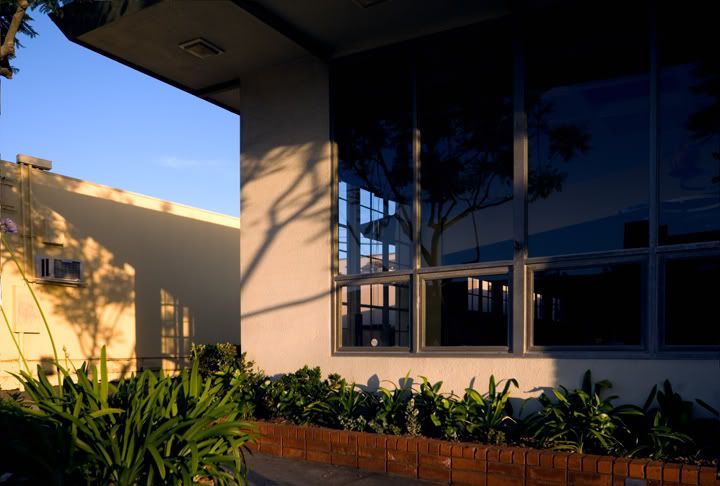
The Mission Hills Library is not unlike the first library I ever knew in National City. Both employed brick and lots of window glass. They had different roofs though. National City’s roof had a lower profile. The Mission Hills Library roof almost takes flight.

National City’s mid century library closed years ago. That South Bay city can boast having a fine looking slick modern library. San Diego on the other hand limps along with a collection of libraries that have been way too small for a very long time. It is a city that has pumped hundreds and hundreds of millions of tax payer dollars into sports stadiums and guaranteed purchases of unbought Chargers tickets. For Petco Park alone the city will be playing to the tune of eleven million dollars a year until 2037. Mean while the city has been unable to fund its employee’s pension program, maintain its infrastructure, or to build modern libraries, especially a central library.

Still, the days are numbered for this little jewel. It may have outlived its usefulness as a library, but this is a smart looking warm friendly structure that can live on wonderfully serving some other purpose. It astonishes me to hear the number comments people make while I shoot old buildings. “What are you doing that for? I can’t wait for the bulldozers to knock this down!” I would have thought library patrons might have more sense of history and culture–especially about the library that served them so well, so long.
And its not as if the new library needed this land. The plans are in place for a new library to be built up the street. Maybe I should have asked “what’s the big hurry to scrape this little library for a six story faux Spanish strip mall deluxe loaded with condos and anchored at ground level by Starbucks? You can get that by walking down the street a few blocks. And plenty more a few blocks after that.”

Dan Soderberg Photography

San Diego Neon, continued.

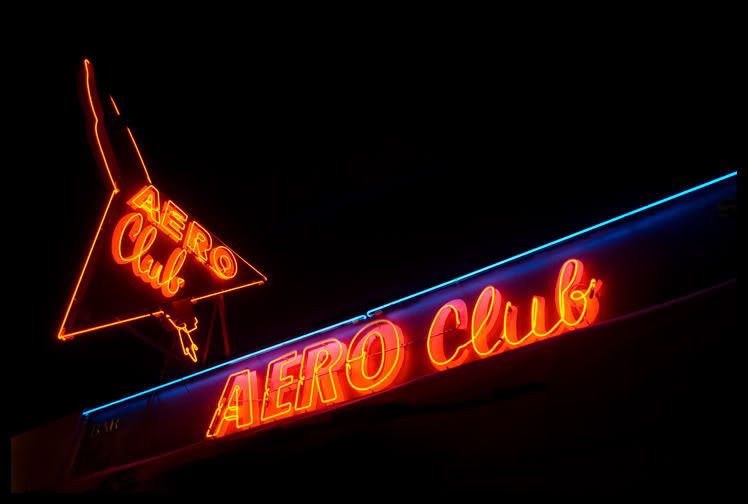
One of the oldies. The Aero Club on India Street has been around for 60 years. The aerospace crowd is long gone, but the joint enjoys continued popularity with the youngins.

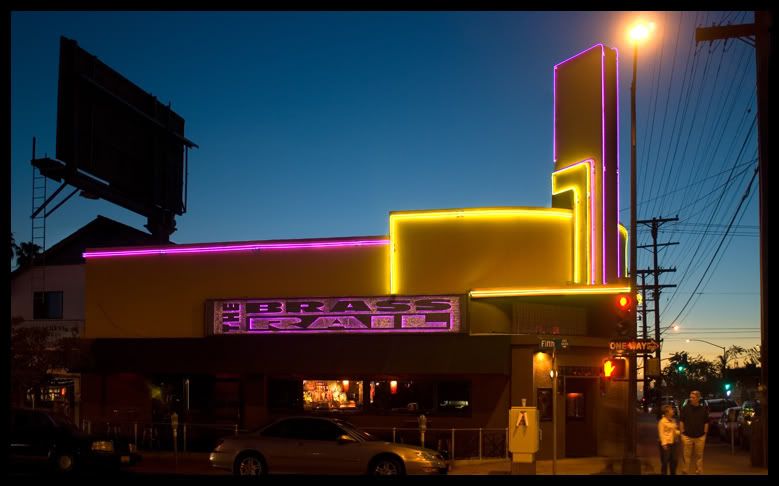
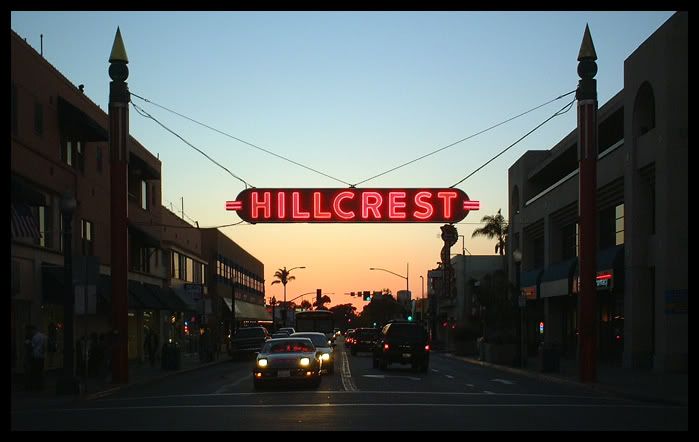
Another ancient water hole, The Brass Rail in Hillcrest. The Brass Rail’s first venue was downtown beginning in the 1930’s. The Hillcrest venue began in the 1960’s. It boasts being the oldest gay bar in San Diego. It was once required back in the old days for men to keep their hands on top of tables or the bar at all times! Police with flashlights stopped by unannounced just to make sure of that. Yes, at least human rights have progressed beyond the “put your hands where I can see them” era.

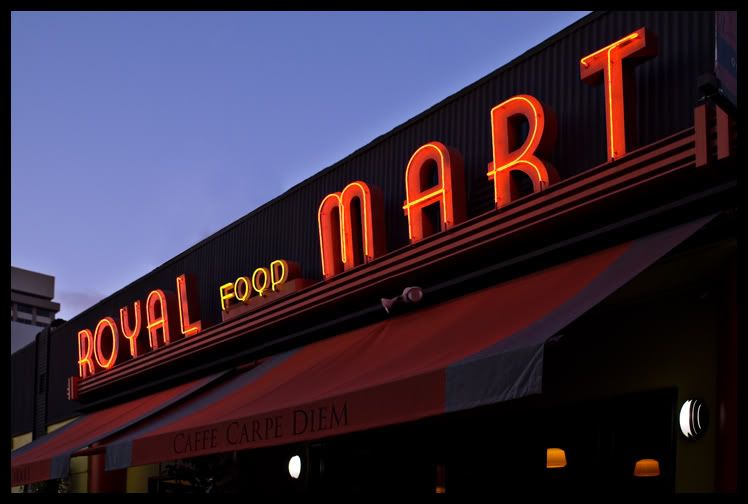
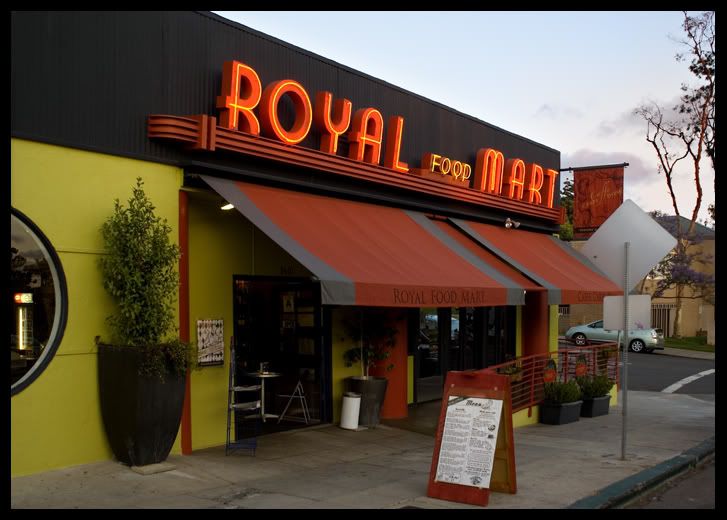
The magnificent Royal Food Mart sign. Located at 3401 First Avenue, this venue has been going since 1914.

A menu is posted at the sidewalk. You’ll find an array of delicious sandwiches made by a friendly young lady named Romi.

I enjoyed a turkey sandwich made on really good coarse sour dough bread.

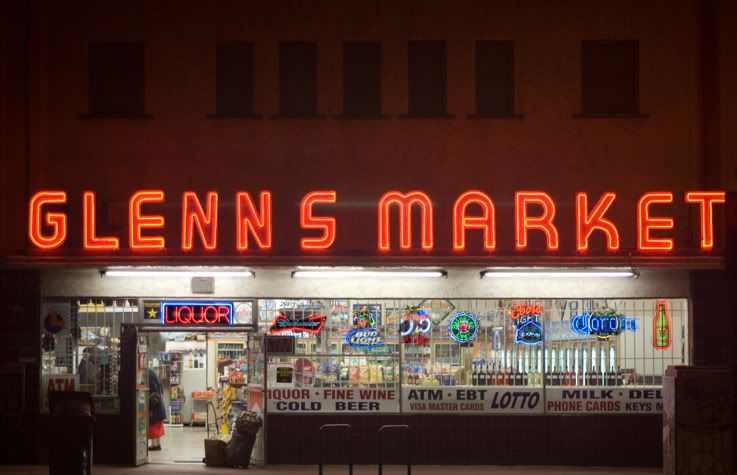
Many of the old markets had neon. Judging by the number of neon beer signs, Glenns appears now to be more liquor store than market.

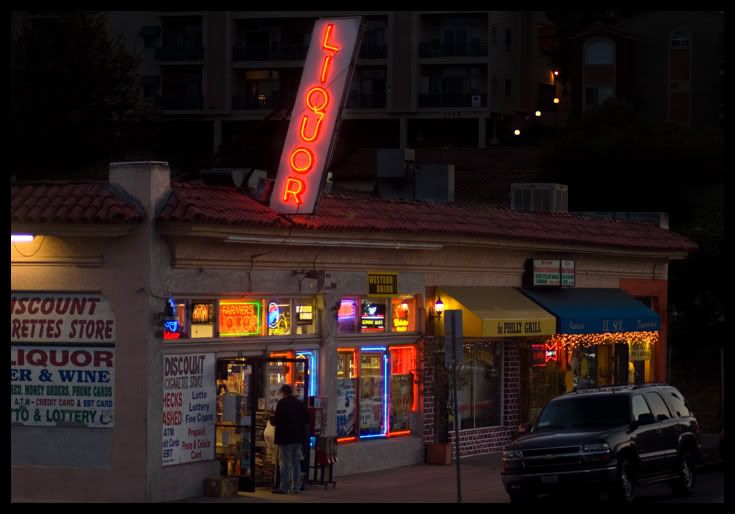
Many liquor stores retained their neon even when this form of lighted sign fell out of favor in the 1970’s and 1980’s.

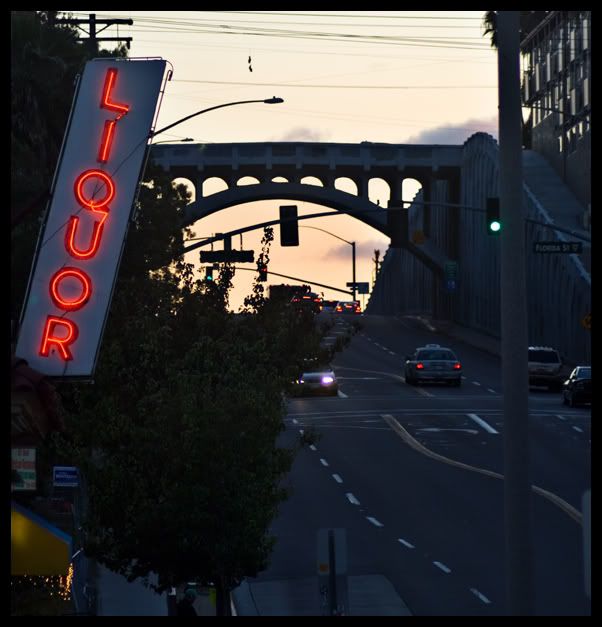
Signs were often situated in a way that waved to traffic and pointed attention to the store. The Georgia Street Bridge at University Avenue in the background.

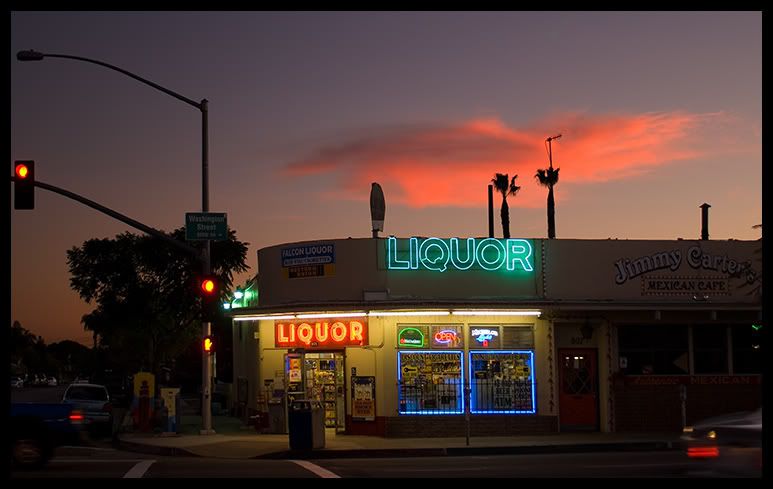
The lining of windows with neon is becoming a more common sight. Falcon Liquor on Falcon at Washington Street, Mission Hills.

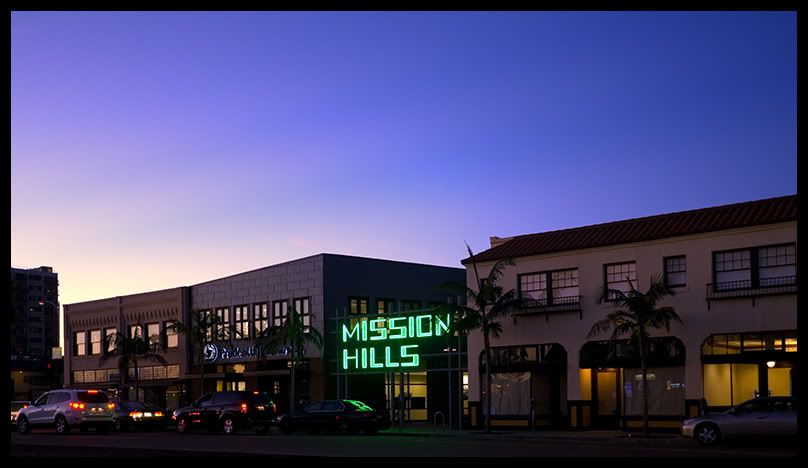
This is an example of what developers like to call “mitigation.” The old structure, The Mission Hills Shopping Center–the neon letters were spelled across the facade–was demolished. The “Mission Hills” portion of the neon was tokened back to mitigate the loss. This particular view of the sky from this vantage point will not be possible in the near future. One enormous building is going up around the corner. A tall sheer block behind these buildings will cover much of the sky seen in this photo.

One could do a photo essay of the neighborhood neon signs alone.

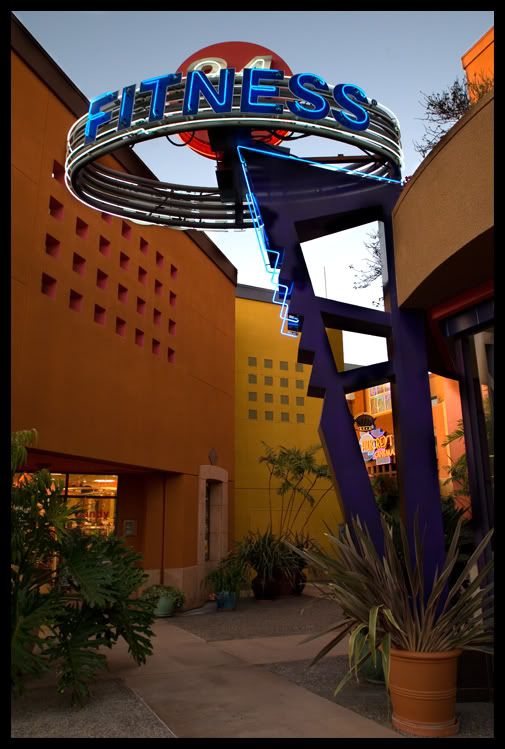
24 Hour Fitness Neon. Hillcrest Cinema neon through the uprights.

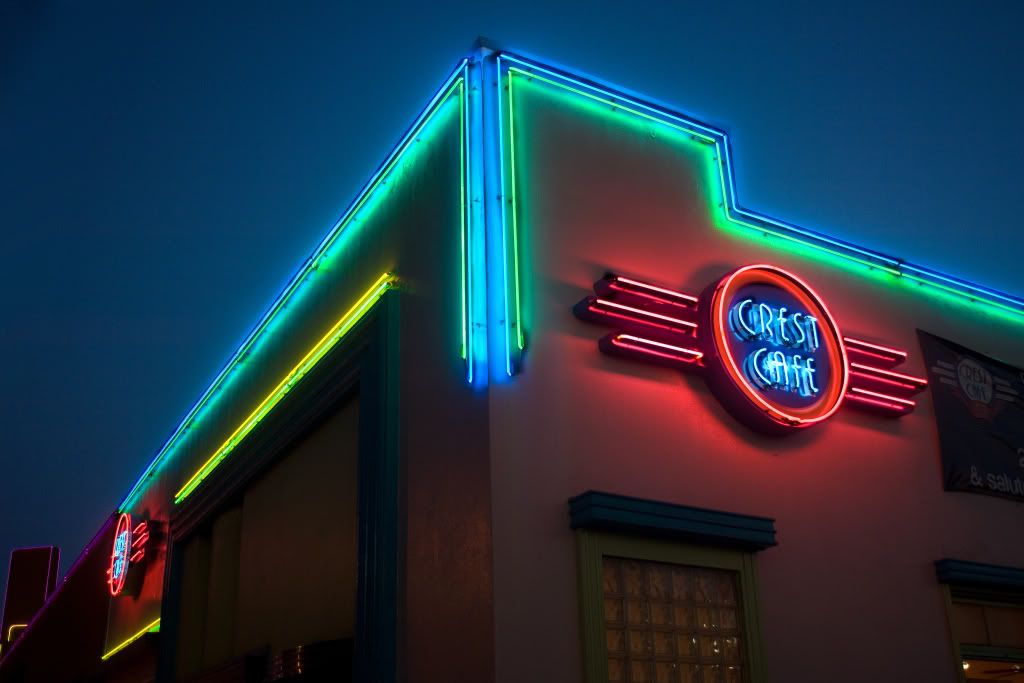
Crest Cafe, Hillcrest, went all out with neon a few years ago.

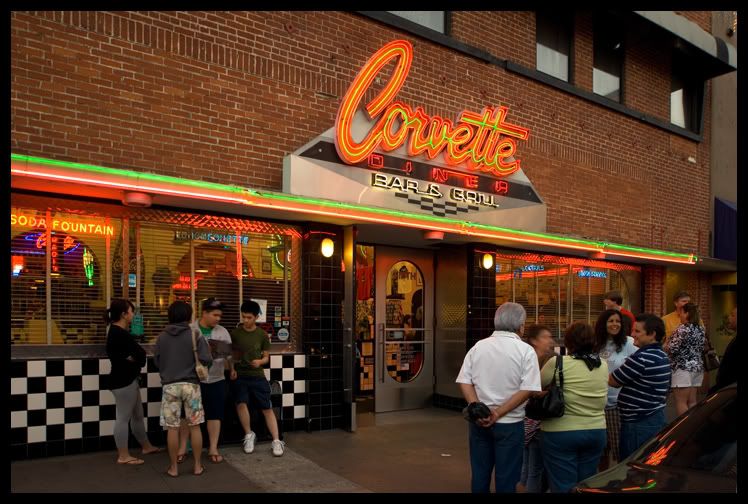
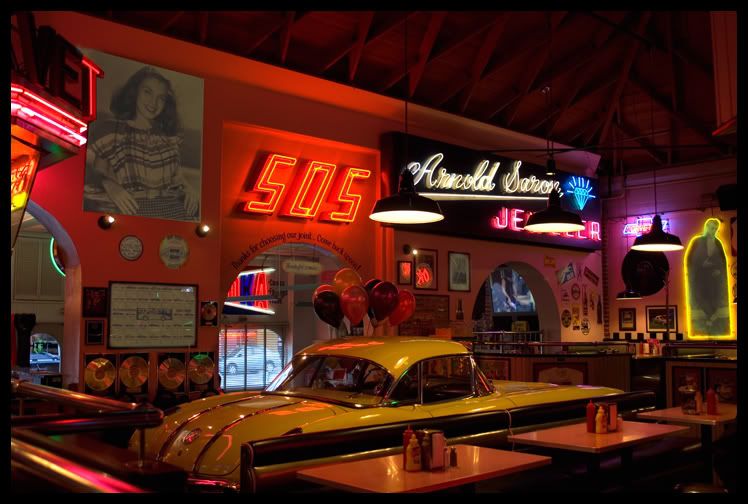
Although the popular Corvette Diner has a handsome exterior neon display, the best is found inside.

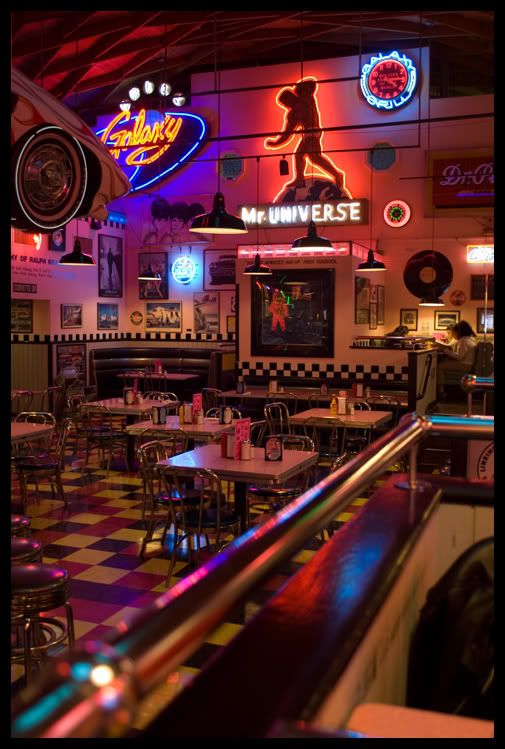
Corvette Diner has a collection neon signs from a number of extinct establishments. The Mr. Universe neon sign I remember very well from my childhood. Mr. Universe was Earl Clark. His gym was in Chula Vista, and my dad was a member. I worked out there too, but working out bored me at a young age.

The old Arnold Saron Jeweler sign.

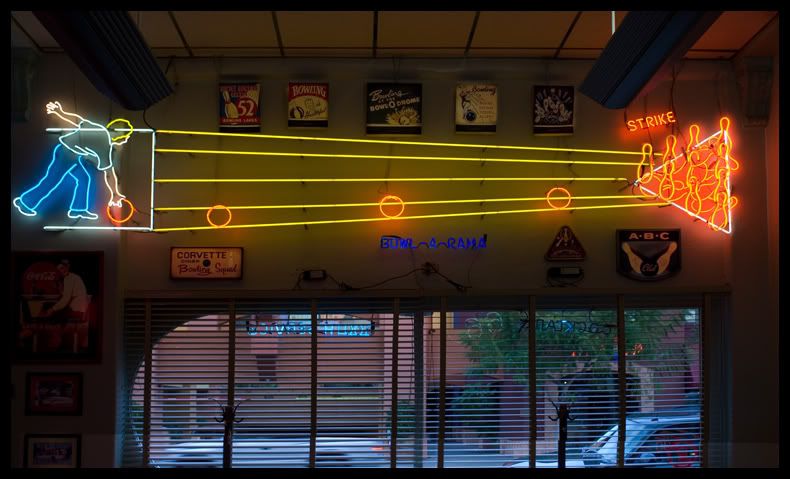
This might be their best one. An animated bowling alley neon.

Dan Soderberg Photography

Boulevard Memories: The Neon

A fellow Boulevard fan, Steve Freed–who grew up around The Strip–remembers El Cajon Boulevard as “a sea of
neon.”

“Not only was it a sea of neon,” he said, “but it was animated neon.”

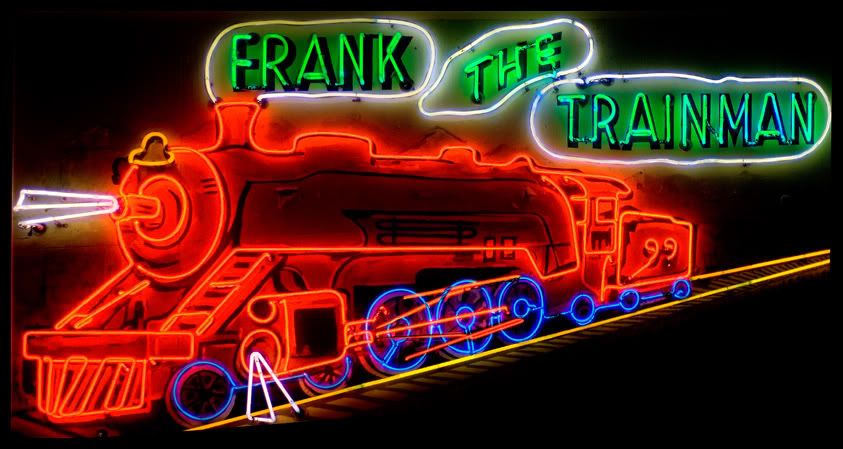
Frank The Trainman, though actually addressed on Park Boulevard, is poised in perfect view at the head of El Cajon Boulevard. Though the storefront attached to this sign was razed, the sign was preserved for the new structure.

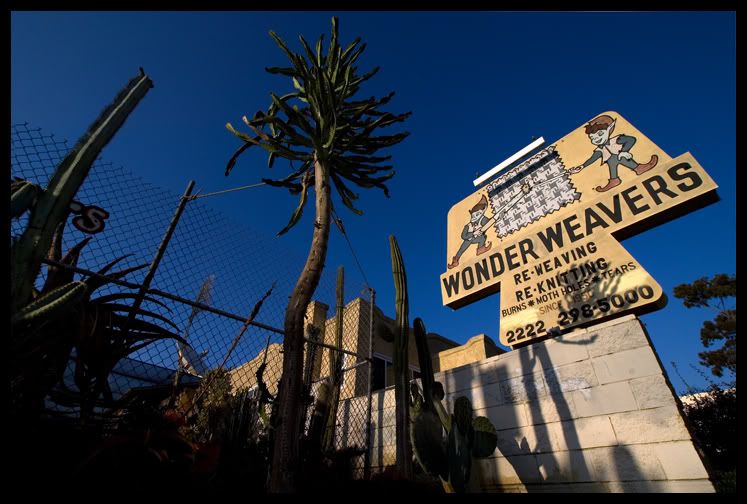
This Wonder Weavers sign was among El Cajon Boulevard’s most appealing animated neons, said Steve Freed. Nowadays you can see the holes where the neon was held. But no neon today.

Steve Freed, 1977
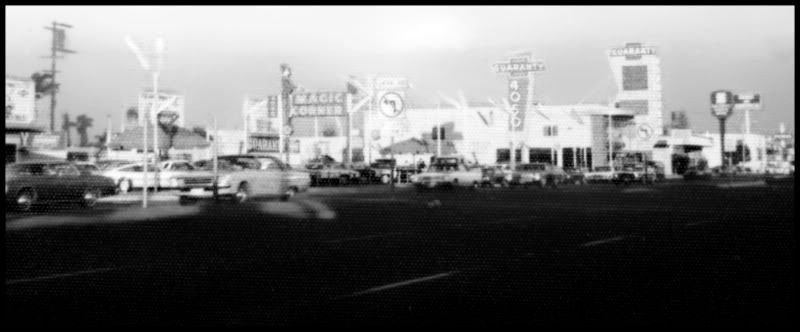
Steve brought me some pictures from his photo album to scan and work on. This one was a bit tough to work with, but I included it here because the Magic Corner at Guaranty Chevrolet was a great piece of neon animation. That’s a neon outlined magician figure at the Magic Corner sign. He waved his magic wand.

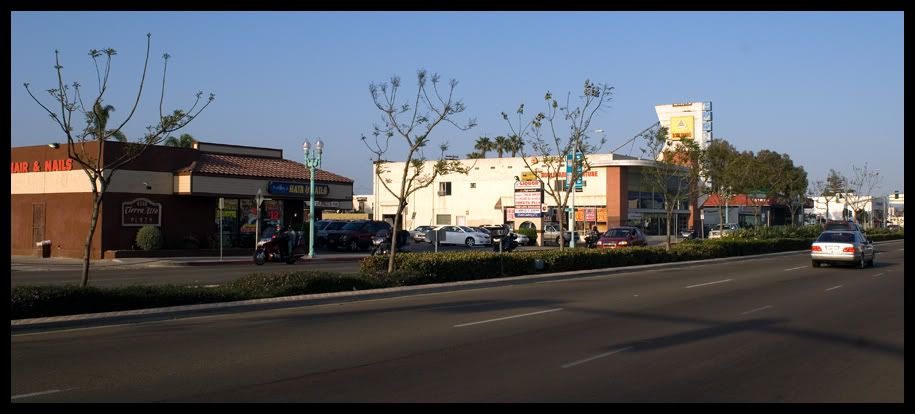
No more magic at that corner. Just an ugly strip mall. The Guaranty Chevrolet building, now dilapidated, is a furniture store.

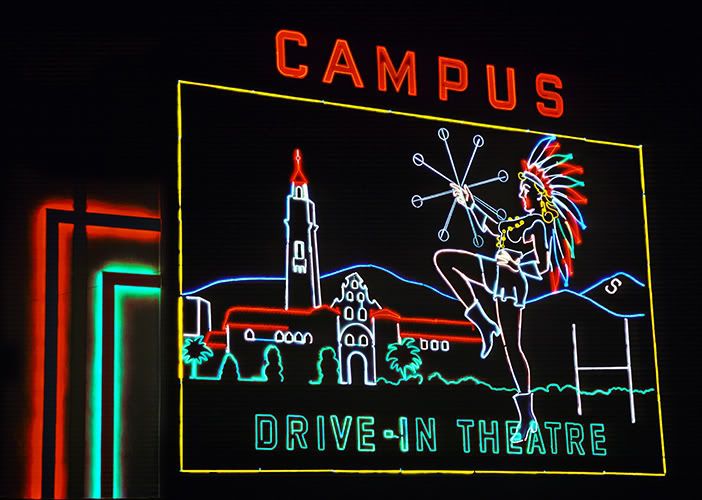
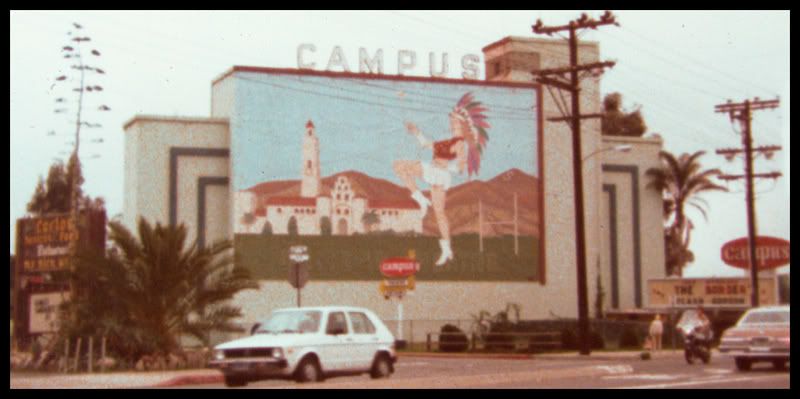
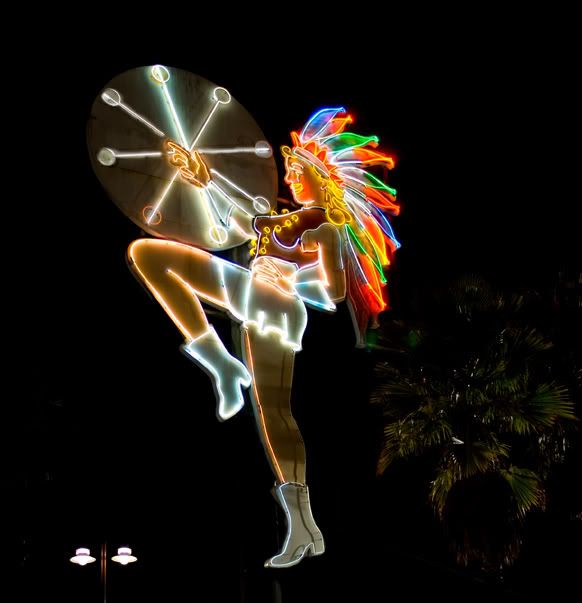
The undisputed queen of Boulevard animated neon, The Campus Drive-In Theatre.

S. Freed, 1982

Steve snapped this shot in 1982 just before The Campus Drive In’s final curtain. Although the Majorette was saved the mural and all the artwork associated with the scene surrounding the majorette was demolished. The neon outline of the mountains, campus buildings, and the letters no longer accompany the baton girl.

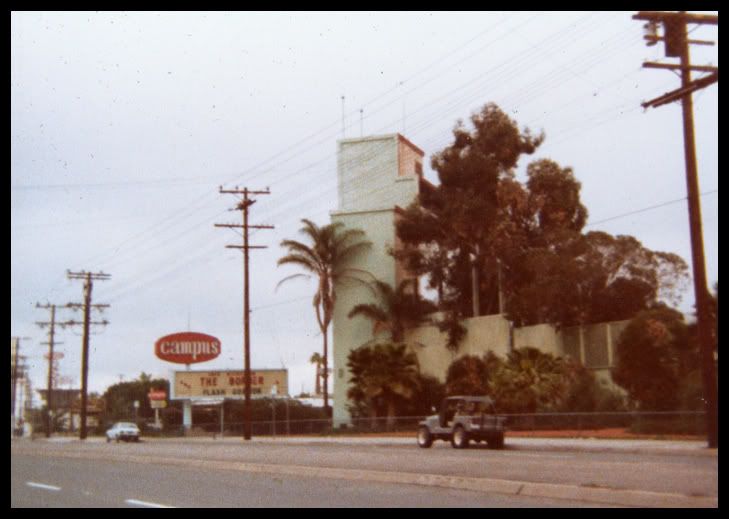
S. Freed, 1982

Said Steve: “Trees were grown to surrounded the sides of the movie screen because cars used to park and watch a movie from the street.”

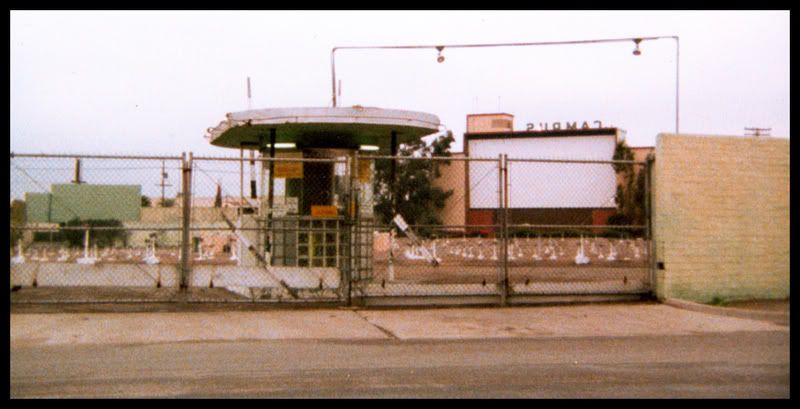
S. Freed, 1982
Campus Drive-In Ticket Booth.

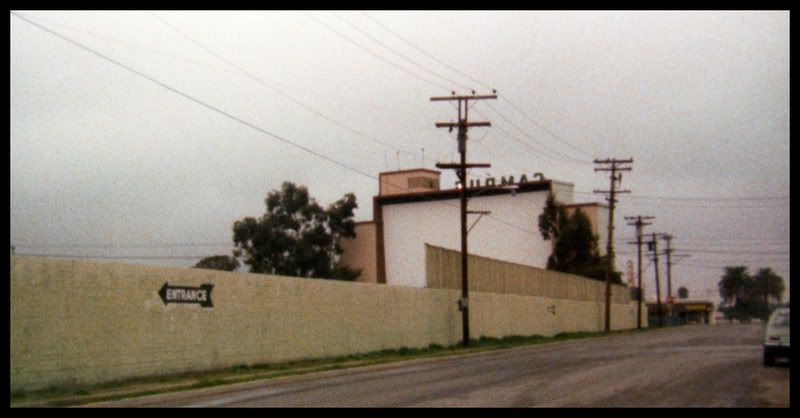
S. Freed, 1982
Side street to the ticket booth.

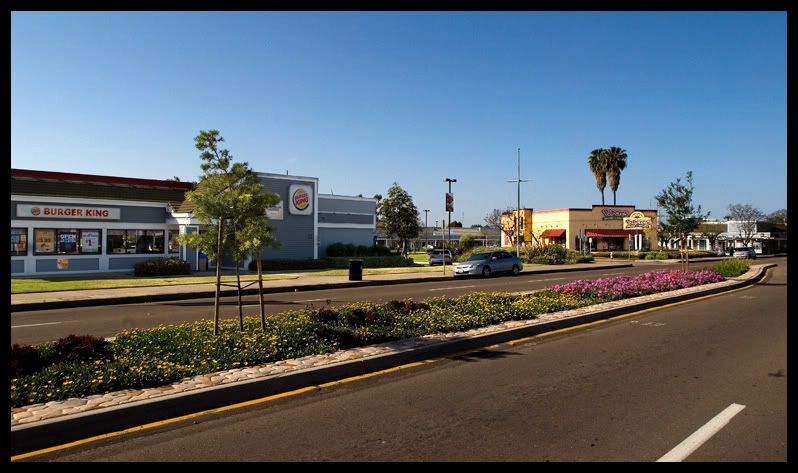
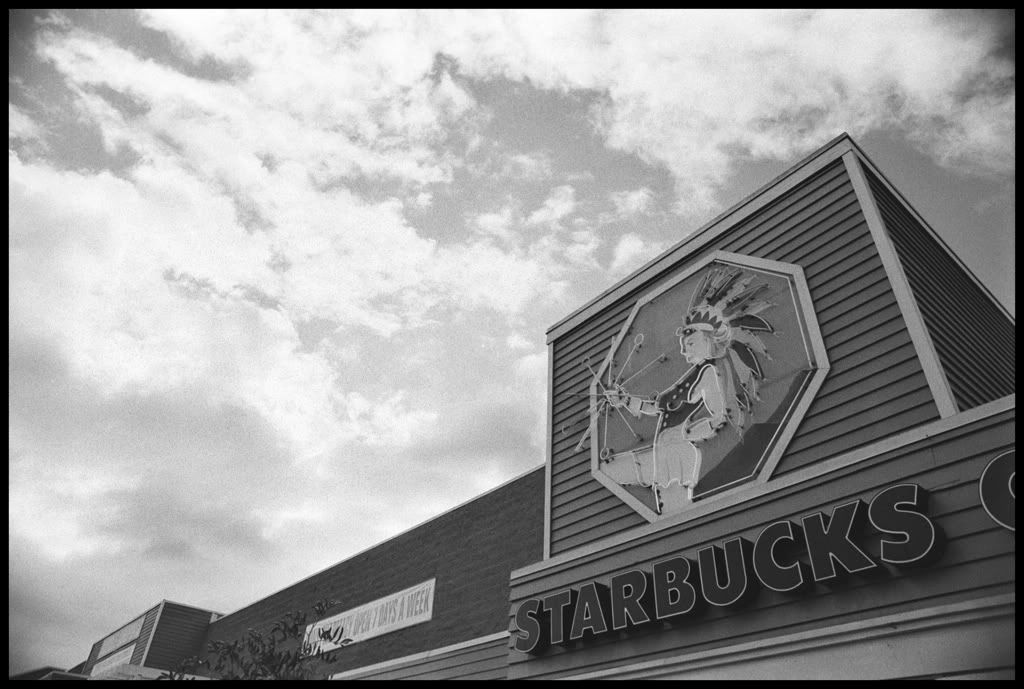
The Campus Drive-In Majorette today at College Grove Shopping Center. I took the liberty of cropping out the marvelous Mervyn’s back-lit plastic sign. She twirls away just a proudly as ever.

There’s not a lot to see at the site where the Drive-In once stood so dramatically.

There are small token neon majorettes sprinkled through the development to pay homage to what once stood there. But otherwise you’d have to say one old icon was replaced a new one. Starbucks.

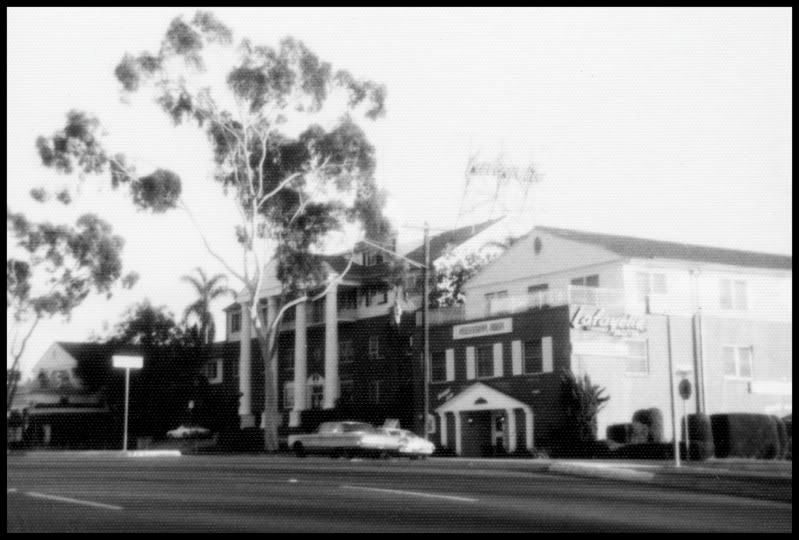
Steve snapped The Layfayette Hotel in 1977. The neon was still intact.

Changes are due for the Layfayette as well. At one point it faced demolition. Then compromise. The facade was to be saved as a front for a behemoth high rise behind. That apparently is still the plan, except the height has been reduced, “Mitigated.” Let’s hope it works better than other completed hybrid projects around town.

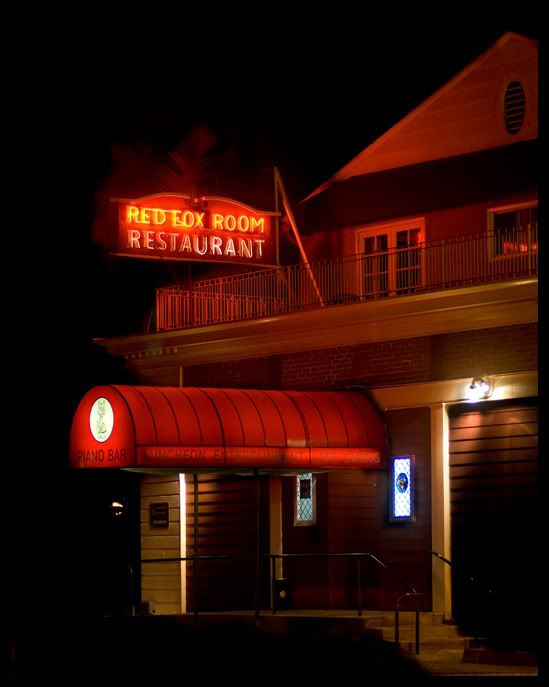
The Red Fox Room at the Layfayette kept the neon.

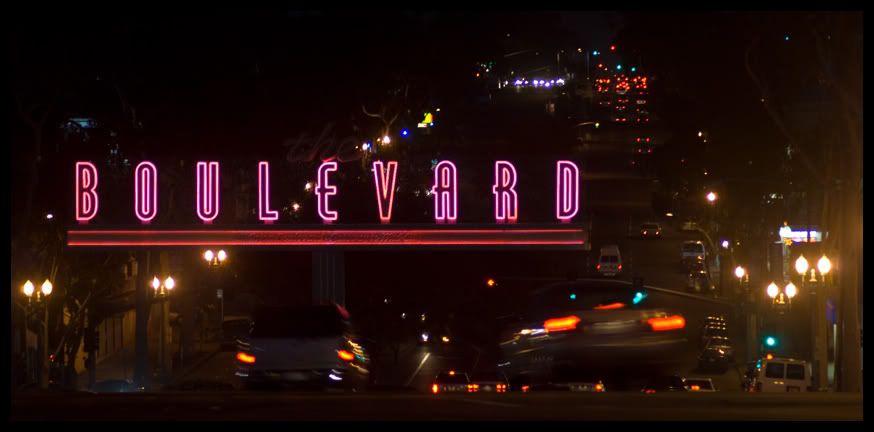
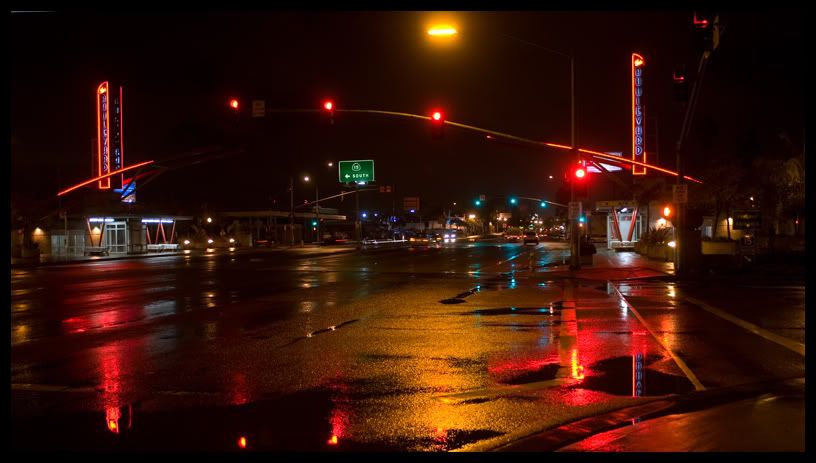
Neon is coming back. Perhaps it will never again rival the glory days of the 1950’s, but neon is gaining favor once again. This is the new transit plaza on El Cajon Boulevard at Interstate 15.

Next: Boulevard Memories: Sights Then and Now. Comparing various Boulevard sites with “before” and “today” shots.

Dan Soderberg Photography

Spring


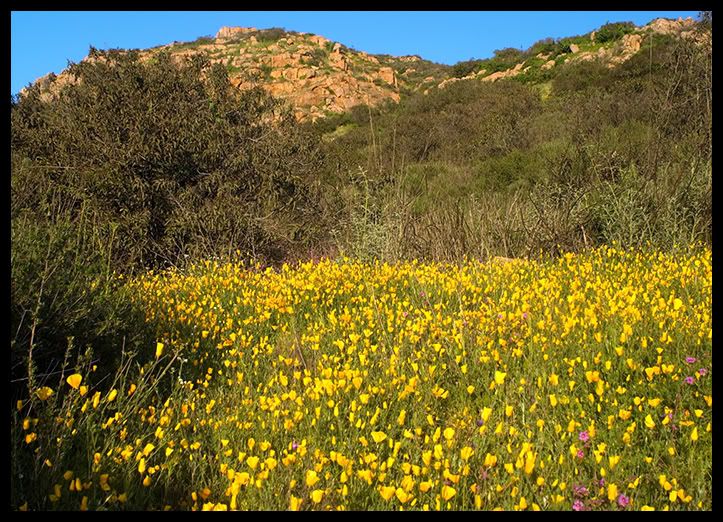
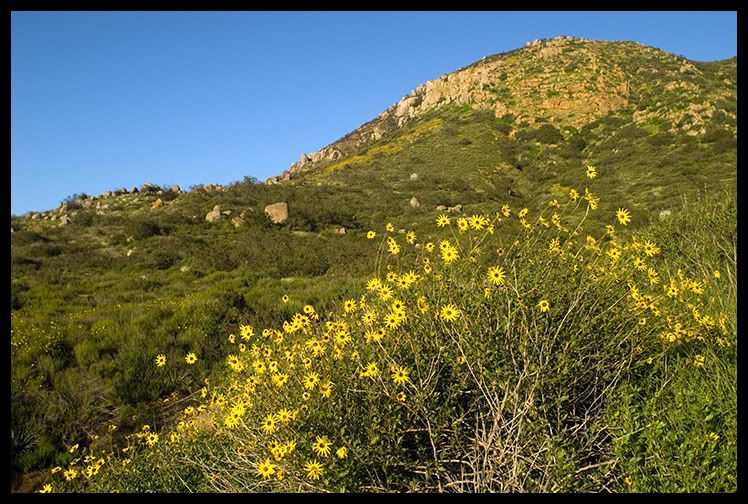
When San Diego has an ample rainy season, the otherwise dry chaparral countryside becomes green for a brief period in Spring.

Poppies do their popping.


Butterflies fly. Wild Animal Park

Wild Daisies at Mission Trails

Monarch Butterfly at Wild Animal Park

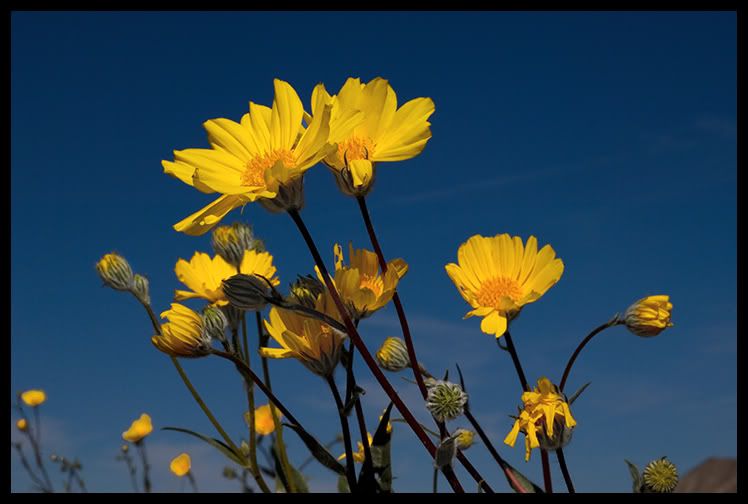
Wild Flower at Mission Trails.

Wild Animal Park

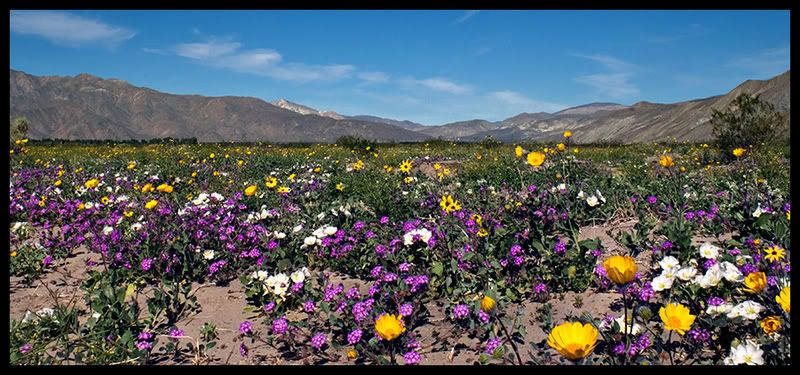
Desert rain puddles and dries quickly leaving cracked plates. Flowers quickly emerge. Anza Borrego.


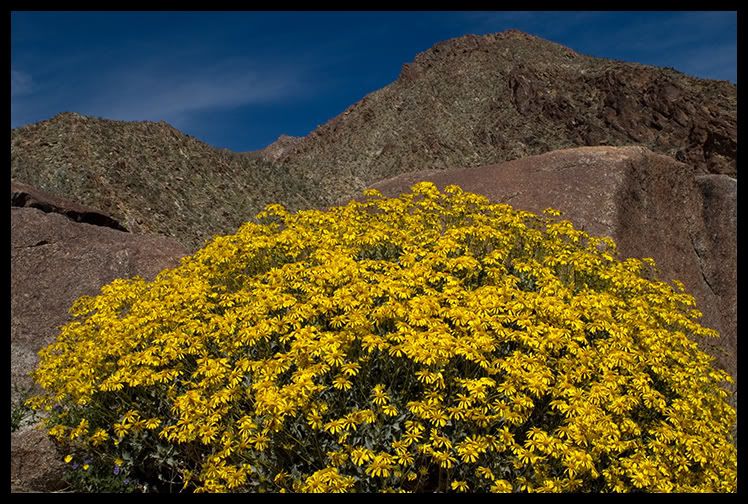
And More Flowers. Anza Borrego.

Anza Borrego

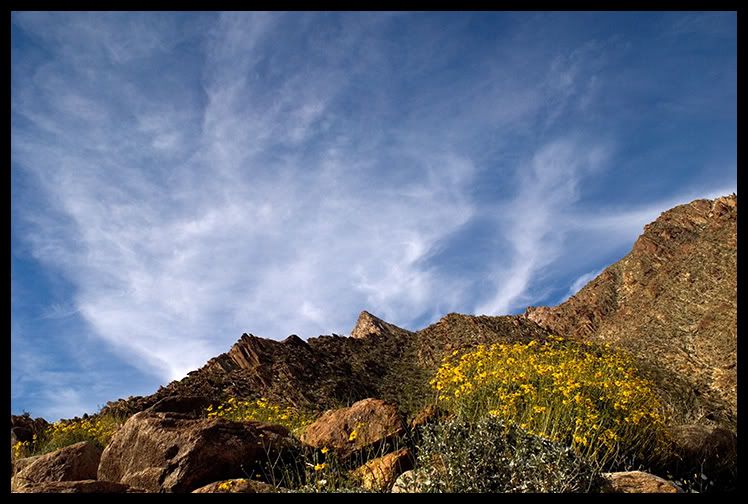
Along Palm Canyon Trail, Anza Borrego.

Palm Canyon Trail, Anza Borrego.

Palm Canyon Trail, Anza Borrego.

More Butterflies, Wild Animal Park.