Lucky was the dog that got his own Frank Lloyd Wright designed dog house. It is at the 1951 Frank Lloyd Wright designed Robert Berger House in San Anselmo, CA. The house is unique in a couple of ways. First it was a “do-it-yourself” construction project. From the years 1951 – 1973 Robert Berger built his own Frank Lloyd Wright house by hand, so to speak. And Second, it features the above custom designed dog house.
I got to meet Mr. Berger and his wife in April of 1971. They generously allowed me to photograph the house, and they enjoyed sharing information. He told me although the work could be physically demanding he had no difficulty following Wright’s plans and instructions even though he had no previous house building experience. It was designed so it could be built in phases. It began as a one bedroom house, then became three bedrooms with the addition of another wing.
Wright utilized a number geometric layouts for his Usonian homes. The Berger House is based on a diamond module. 60 degree and 120 degree angles.
Character defining features of Wright’s work. Generous use of rock, wood, and glass. The broad overhang. The mitered window corner.
The rock walls are made with wood forms. Desert rocks piled into the forms, and concrete pushed in to ooze between the rocks. It’s a technique Wright devised in the desert of Taliesin West.
As so often the case with a Wright home, you enter through a low passage way and enter a larger expansive space within. The cut out pattern windows are a Wright signature design feature.
A peek within. “The Hearth” was always a focal point of Wright’s living areas. When construction was finally complete, it includes Wright designed furniture.
Welcome to Springbough. Beyond the FLLW designed gate is the Frank S. Sander House in Stamford, Connecticut. Source Dami’s Findings
Springbough was completed in 1955. I had a chance to visit in August of 1980. The home since then went through a period of decline. But in 1996 was lovingly restored by Anne Del Gaudio.
It is a 2,200 square foot Frank Lloyd Wright designed home on 2.3 acres of land. Ms. Del Guadio bought the house after the death of her husband, a Scarsdale dentist. Buying this home was a new life for her.
Wright’s design, built onto a rock outcropping, makes her feel “connected to the earth,” she said, adding, “As a widow I need that grounding energy.”
Ms. Del Gaudio spent several hundred thousand dollars replacing 14 skylights and restoring all of the exterior mahogany to its original amber finish. She also repaired extensive water damage to walls and ceilings. “Wright never built a roof that doesn’t leak,” she said.
She made the house glisten. But in 2003 she put the house on the market.
“I babied the house,” Ms. Del Gaudio, 65, said. “Now it’s someone else’s turn.”
She enlisted the help of the Frank Lloyd Wright Conservancy to help find a sympathetic owner. Source NY Times
A sky-lit living space cantilevers over a rock outcropping. Wright was close to 90 years old when this house was built. It was also the most prolific period of his long career. “I can’t shake them out fast enough,” he said, demand for his work was that high.
Springbough, detail. Brick and Mahogany.
Springbough entrance. WoodDance studio has a story to tell about the restoration of these doors. It’s a bit scary!
“Not too long after I started working on a Frank Lloyd Wright home here in Connecticut I was asked to fix the front storm door because it was badly warped and one of the screws holding the handle in place had stripped out, leaving the handle a bit loose.
After altering the door in my shop I brought it back to the residence and set it outside. I left it leaning there against the stone wall in the carport while I worked on the jamb and passive side. I replaced the passive side and left for the night.
The next morning at 5:30am the garbageman stopped to collect the trash and for some reason, took the door as well.
When I showed up at the job site, just a few hours later, and couldn’t find the door, panic set in. We raced to phone the sanitation company. They said the door had been taken, dumped at the transfer station and had by now been driven over by large debris moving caterpillars. The original Frank Lloyd Wright front storm door was destroyed!
While working on this home, I removed some large boards of mahogany from the deck area. Every piece of this Frank Lloyd Wright original that I removed, I labelled and stored neatly in one of the out-buildings. I brought a few pieces to my shop and reconstructed the door using that material from the site.
Having the opportunity to affect repairs on what I consider to be an important structure, at times, holds more meaning to me than to the client. The work I do, in a way, can be a personal interaction between myself and the original Architect, Builder and/or carpenters. I have my hands on things that homeowners never see; the guts of a house. In a forensic sort of way, I can get a feeling for the job as it might have been for the crew putting it together.
Using wood that came from the house was important to me but furthermore I wanted to use wood that Frank Lloyd Wright likely had set his own hand upon.
Frank Lloyd Wright began using the red square symbol as his signature mark around 1904. This home was built in 1952. In this image we can see the original signature block on the left hand side.
Thank the lucky stars we didn’t leave that door off too!”
In the early 1920’s Frank Lloyd Wright sought to create a new architectural vocabulary for California. One not based on Spanish Colonial, Mission, or Craftsman. Wright almost never pointed to inspiration for his designs, but one can certainly have a hunch he tapped the ancient Mexican and South American civilizations for the look of his concrete textile block homes in Los Angeles in 1923 and 1924.
The first of these homes was the Alice Millard House in Pasadena, 1923.
This was the second home he designed for this particular client. The previous one was done 17 years earlier in Highland Park, Illinois, for her and her late husband. Wright said he was proud to have a repeat client. “Out of one hundred and seventy-two buildings this made only the eleventh time it happened to me. So, gratefully, I determined she should have the best I had in my portfolio.”
Indeed it is regarded as one of his best. Brendan Gill wrote “La Miniatura is assuredly among the most beautiful houses to be found anywhere in the world, regardless of size.”
Gill questioned, however, the wisdom of the site chosen for the home. It is an arroyo. “For obvious reasons (it is) not thought desirable as a building site. So Mrs. Millard was able to acquire the arroyo property at a low price. Flying in the face of conventional prudence, Wright and she decided to build at the bottom of the arroyo, where a small pool would be dug to reflect the house.” All four of the textile block homes Wright built in L.A. in 1923 and 1924 had water damage issues. Gill may well have a point. But clearly both client and architect loved where the house was built.
“The interior is as exquisite in its shapeliness as the exterior and has a plan of remarkable ingenuity, comprising three full floors and terraces at four levels, with easy access to it surroundings and to the street.”
The concrete block as a construction material was not new in 1923. But Wright’s construction method was unique. As well as his attention to design pattern. He envisioned this becoming a low cost way to build elegant homes–a design goal he remained interested in decades after these first experiments. Unfortunately the textile block homes of this period all went over-budget and proved to be very difficult to build. They are imperfect works of great art. But as works of art they are very important in history. The effort to save these homes has been a challenging cause, if not heroic. The fate of the Millard house has been uncertain for years. One investor wanted to move the house to another site. I suspect it was determined to be infeasible, and would have been a disaster. From what I can tell the house is currently for sale. Here is the agent selling the home–providing some great interior shots for us to see.
Mom and Dad rented an apartment in this grand house at 5th and Grape, San Diego’s Bankers Hill, during World War II. They told about being able to nearly make eye contact from one of those windows with people in airplanes landing at Lindbergh.
Mom and Dad in Balboa Park, a short walk from their home. The listing is from the 1944 Voter Register. Dad was a rifle instructor in the Marines. Mom worked in an aircraft factory.
A map of the corner at 5th and Grape from 1906. It is the footprint of the house where Mom and Dad lived. It was the Mossholder Residence.
The Mossholder Bio.
What’s there today. The two grand homes on this side of the block were demolished for a parking lot. The retaining walls and stairs leading to the residences remain–the corner stairs covered in vines.
A glimpse of the original stairs and retaining wall at the corner of 5th and Grape. A sleeping bag indicates the vines provide shelter for someone still calling this corner a home.
As so often the case, great architecture was demolished to make parking lots.
The remnants of the second home on that block leveled for parking are very visible. And interesting to look at.
The medical clinic would do the neighborhood a favor by repairing and painting these doors. And help save a tiny slice of history too.
The stairs are still in use today.
Someone has taken the time to plant some flowers.
An impression at the base of the stairs. The same “stamp” is at both sides below the bottom step. Likely whomever built the stairs and retaining walls.
The 1908 City Directory shows a couple possibilities about the origin of the Jennings stamp.
Thanks to Sarai Johnson for providing some of these great visuals from her archives.
It is one of San Diego’s most familiar landmarks. The regal Art Deco Streamline Moderne Fat City building located at 2137 Pacific Highway. It is home to Fat City Bar and Steakhouse, China Camp (now closed), and Denny’s. Its owner, Tom Fat, renown restaurateur and prominent figure in San Diego’s Asian Pacific Islander community, passed away in 2007 at age 66. Some four years later the landmark building that is/was home to his highly successful eateries appears headed for demolition.
It Stretches Out Regally and Sphinx like
Tom Fat took over the boarded-up site in 1977 and brought the classic art deco complex back to its former glory. He practiced sustainability before anyone even heard about it. That trait was likely learned from his father Frank Fat. In 1939, Tom’s father took over a run-down building in Sacramento, only a block from the Capitol building, and turned it into the celebrated Frank Fat’s restaurant.
Fat City – China Camp Neon
The restoration and remodeling took nearly 3 years. The crowning touch was the installation of a mile of neon–certainly San Diego’s most wonderfully opulent neon showcases. A richly colorful and now rare art form. Tom Fat paid homage to an elegant era of design by bringing back this building’s flamboyance and flair.
Tom Fat’s great work earned him a 1981 Orchid Award–one of San Diego’s highest architectural honors. Fat City’s neon art and architecture became feature articles in San Diego Magazine, Designer’s West, Times Magazine, Lighting Dimension, and the Smithsonian Neon Art photo magazine.
The restaurants helped energize the restaurant scene of all downtown. The Fat City Steakhouse became ground zero for power lunches and dinners where local leaders were known to gather. Tom Fat was highly involved in and dedicated to the community. He was close to elected representatives, and many called upon him for advice.
Our research is still in progress. But we know this Art Deco treasure was built between 1940 and 1942 as Big Top Restaurants. Then a few years later it was just known as Top’s. The early name most famously associated as proprietor was Yale Kahn. He and his brothers were sons of Russian Immigrants who instilled a sense of hard work in their children. Brothers Irvin, Henry and Julius Kahn made their mark in San Diego with real estate development in Clairemont, University City, Rancho Penasquitos, and Mira Mesa.
But Yale Kahn was a fulcrum around which all the major popular nightclub entertainment in San Diego spun. The San Diego Union stated “Yale Kahn, a man whose knack for business earned him a spot in San Diego history†(San Diego Union November 8, 1959). Constantly in the news media spotlight during the 1950s, the Kahn brothers brought nationally and internationally famous performing acts to his restaurants and nightclubs and rubbed shoulders with politicians and business people throughout the region.
Top’s was San Diego’s Hot Spot for Entertainment
At Top’s Nightclub Yale brought in top stars of the day. Nat King Cole, Shelley Winters, Nelson Eddy, Van Johnson, Don Ameche, Susan Hayward, Dan Rowan and Dick Martin, to name a few. He made Top’s an entertainment capitol in San Diego.
Yale Kahn also ran the Texas Liquor Houses, the Roaring 20’s Nightclub on Fletcher Parkway in El Cajon, the nightclub in the Clairemont Bowl and Bradley’s (restaurant and nightclub) at Horton Plaza in the mid 1950s, making entertainment available to families. But one of Kahn’s most popular venues were the Chuck Wagon Restaurants in San Diego–most notably the Midway Chuck Wagon with its Gaslamp Room.
The Stars of the Gaslamp Room
The Midway Chuck Wagon and Gaslamp Room drew enormous crowds to see such famous entertainers as Louis Prima, Billy Daniels, Shelly Berman, Mort Saul, and Dr. Dean (hypnotist). Regis Philbin worked there as a Master of Ceremony.
Some common links between Tom Fat and the Kahn Brothers. They all stood in high esteem in the eyes of politicians and business people in the San Diego Region. Top’s night club attracted both political and business leaders, just as Fat City Steakhouse did years later. This magnificent structure stands as witness to their noble efforts, these exemplary business leaders in San Diego history.
Tom Fat once told an interviewer: “I have learned, through the years, that I am my father’s son. He had an immense influence over everything I’ve done. Foremost was giving back to the community, which Fat had done since coming to San Diego in 1976 to expand his family’s business.
Yale Kahn and his brothers built the Circle Arts Theater on Kearny Mesa. It was a dome shaped fine performing arts center, a theater in the round. They were also admired philanthropists with United Way and the United Jewish Fund.
As a business and community leader, Tom Fat served or chaired numerous organizations, boards and task forces, including the San Diego Convention & Visitors Bureau, Super Bowl Host Committee, San Diego Restaurant Association, San Diego Foundation, San Diego Film Commission, Little Italy Association and Asian Business Association, which he helped found. He was also instrumental in expanding the Kyoto Laureate Symposium Series, held here annually.
But of all the things that mattered most in Tom Fat’s life, San Diego’s Asian Pacific Islander community came first. They saw Tom Fat as its heart, soul and, in some ways, its conscience.
The legacies of Yale Kahn and Tom Fat are intimately linked with the superb Art Deco building at 2137 Pacific Highway. And it will be demolished for the above. For THAT!
At a time when we should be observing and utilizing the best practices in sustainability, we continue to burden our rapidly shrinking landfills with huge amounts of demolition rubble of grand historic buildings such as Top’s/Fat City. Evaporating their embodied energy.
This senseless disregard for history–and of such compelling legacies–is something that is almost sickening to try and describe. The feeling you get when you hear about someone taking a hammer to a rare museum sculpture, a knife to a beloved painting, book burnings, or using antiquities for target practice. What words can accurately describe a mindset that doesn’t value our past, the memories of those who came before us, or the cultural riches we inherit?
At this point we are gathering our research to help defend this important historic resources. For now, be aware and outraged this project is even being considered. We will track this development to make sure it goes through the process properly. That the Historical Resources Board has a chance to weigh in, and that feasible alternatives to demolition are properly studied.
Your comments to this posting will be valuable to submit as part of the public dialog, so please don’t hesitate to speak up here. It will help send a message to save this building.
Although Frank L. Hope, Sr. worked in a variety of styles, he was notable as a pioneer Modernist architect whose streamline architecture of 1930’s influenced the acceptance and rise in popularity of Modernism in San Diego.
To call him Frank L. Hope, Sr. is not quite correct. His father, the actual Frank L Hope Senior was a railroad executive and prominent San Diego resident. His son is the above mentioned Frank L. Hope, Jr.
But then Frank L. Hope, Jr. had a son also named Frank L. Hope, Jr. It has been suggested we leave Frank L. Hope, Sr. out of the discussion altogether. And refer to the son as Frank L. Hope Jr, the elder. And his son as Frank L. Hope, Jr. the younger.
Frank L. Hope, Jr. the elder, had worked with Requa, Jackson, Lillian Rice and William H. Wheeler before establishing his own firm in 1928. Hope worked on a number of important commissions including designing a number of custom streamline homes in Pt. Loma. He also designed a good amount of streamline commercial buildings including the 1936 Santa Fe City Offices 1200 Fifth Avenue NW corner at B Street, (demolished) and City Motors Ford (demolished last year).
His son Frank L. Hope Jr. the younger, joined the firm in 1955. Hope Jr, the elder, retired in 1965. The Hope Design Group through 3 generations of Hope family architects had a huge part in creating modern San Diego.
The big dumpster out in front is rather ominous, but the work permits applied for relate only to interior remodeling. SOHO is keeping a close eye on this to make sure the exterior character defining streamline elements are not destroyed.
Streamline Moderne is a part of the Art Deco period of architecture. Also in the Deco fold is Egyptian and Aztec Revival. Above, a Deco detail. The mail slot.
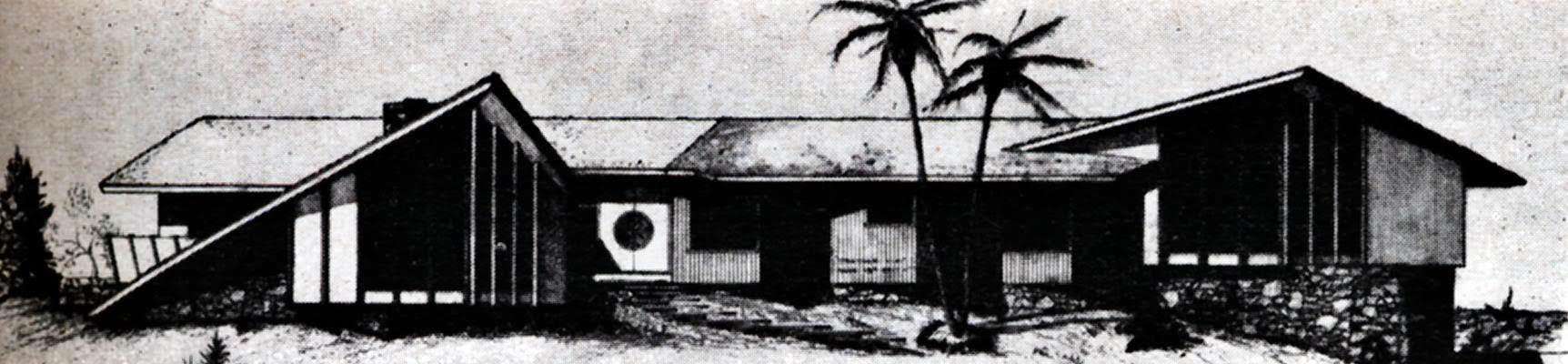
In addition the term Organic Geometric also applies – with the building’s very angular, soaring roof peaks.
It’s the 1961 Marvin Bailin Residence designed by Maggy-Thomas Associates, and constructed by Seabreeze Construction. It was featured in San Diego Magazine.
As Illustrated in San Diego Magazine, 1961
The home was built by Marvin Bailin who owned Seabreeze Construction. Through that he built his own custom house.
The Organic Geometric very angular, soaring roof peaks and floor to ceiling glass also brings to mind a Tiki influence and the futurist Googie look.
The landscaping, the lagoon-like pool, the lanai shaded patio area all speaks to a Pacific and Island influence. The strong influence of Hawaii being granted Statehood in 1959 and a nation wide fascination with Pacific Island culture and design, including Tiki craze.
Marvin Bailin and Seabreeze Construction was known for middle class and luxury apartment projects in San Diego and Southern California in the early 1960’s.
This opulent home was a showcase for Bailin’s success, with a then hefty cost of $90,000 to build.
The Bailin legacy ended abruptly and was forever tarnished when he got busted for criminal embezzlement.
The building by 2010 was in desperate need of repair and restoration.
A lot of apparent wood rot.
Plastic covering which never seems to do what it’s intended to do.
This was the pool house, and now converted living space.
Detail of the lanai.
The pool house falls clearly in the Pacific Ranch Style house category with its board and baton siding and exotic roof beam.
The landscaping overgrowth mostly concealing the home.
Dates listed on this page of the photo album say 1923. Helen graduated from High School in 1921. Helen said she got married right out of high school to Val Rudolph Otto Martin when she was 18. Daughter Jeanne was born September 22, 1923 in Long Beach, presumably at the time Helen and Val began studio work in Hollywood. Note the stack of books and walking stick to her left.
913 Cherry Street, Santa Rosa. Evidently Helen and Val didn’t live here very long.
The house today is in Santa Rosa’s Cherry Street Historic District.
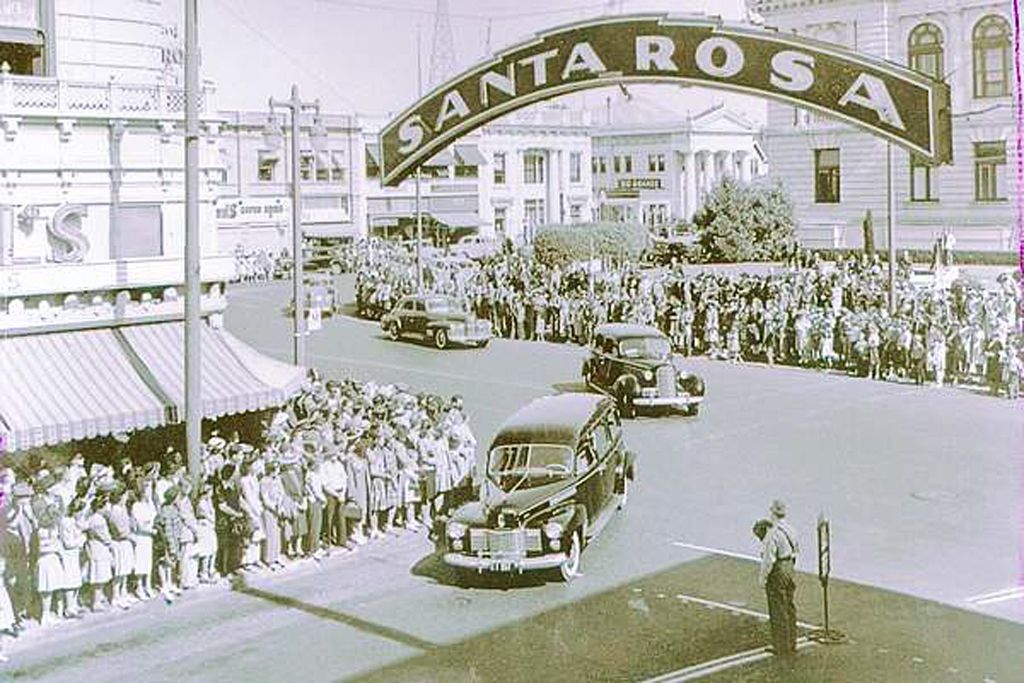
1942 Hollywood publicity photo for Alfred Hitchcock’s Shadow of a Doubt. Photo from Santa Rosa Pressdemocrat
Hitchcock was captivated by the play Our Town. His creative mind was brewing a small town story that would become the film Shadow of a Doubt. He sought Thorton Wilder to write the script, and it proved to be a highly successful collaboration. Hitchcock considered a number of sites to represent his idyllic small American town. After careful scrutiny it was decided Santa Rosa would fulfilled his vision.
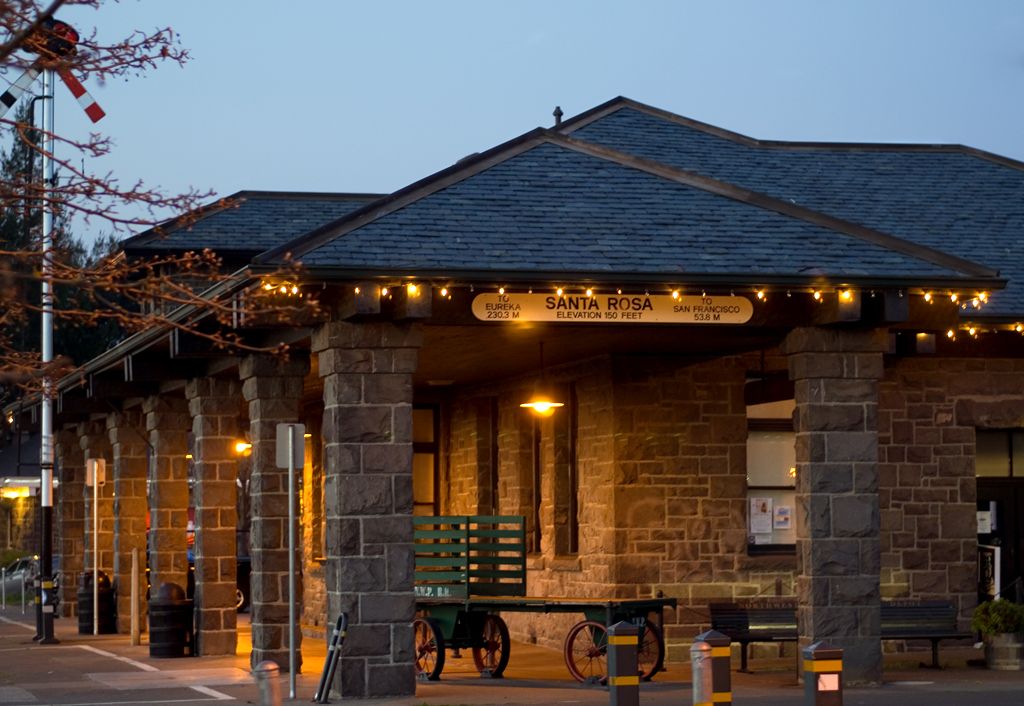
The Santa Rosa Depot is an important feature of Shadow of a Doubt. At the beginning this is where the murderous Uncle Charlie arrives. Hitchcock uses visual foreshadowing when the approaching train casts darkness over the whole station with a black cloud of smoke pumping from the locomotive’s smokestack. The depot figures prominently at the end as well when Uncle Charlie meets his demise there. The departing train puffs a barely noticeable trace of light smoke as the film ends.
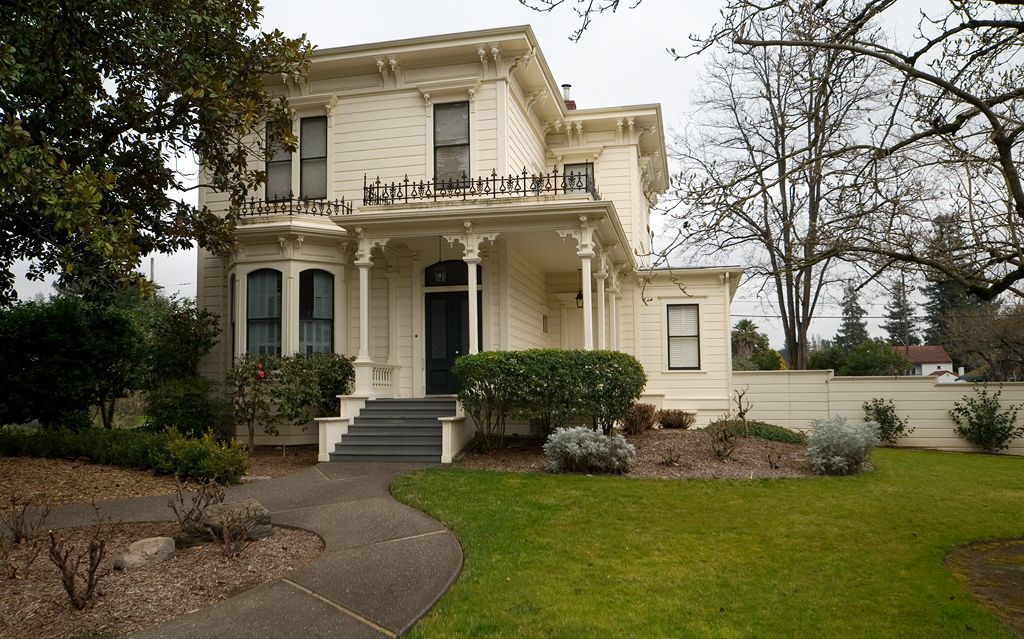
The Shadow of a Doubt house.
Hitchcock and Wilder searched the town for the perfect house to match the one created in their script. The home owner was so proud to have his house chosen, he gave it a fresh new paint job. But that’s not what Hitchcock was looking for.
He got the owner to agree having the house painted again to look dirty! After shooting was done, Hitch made sure the house got yet another sparkling fresh coat of paint.
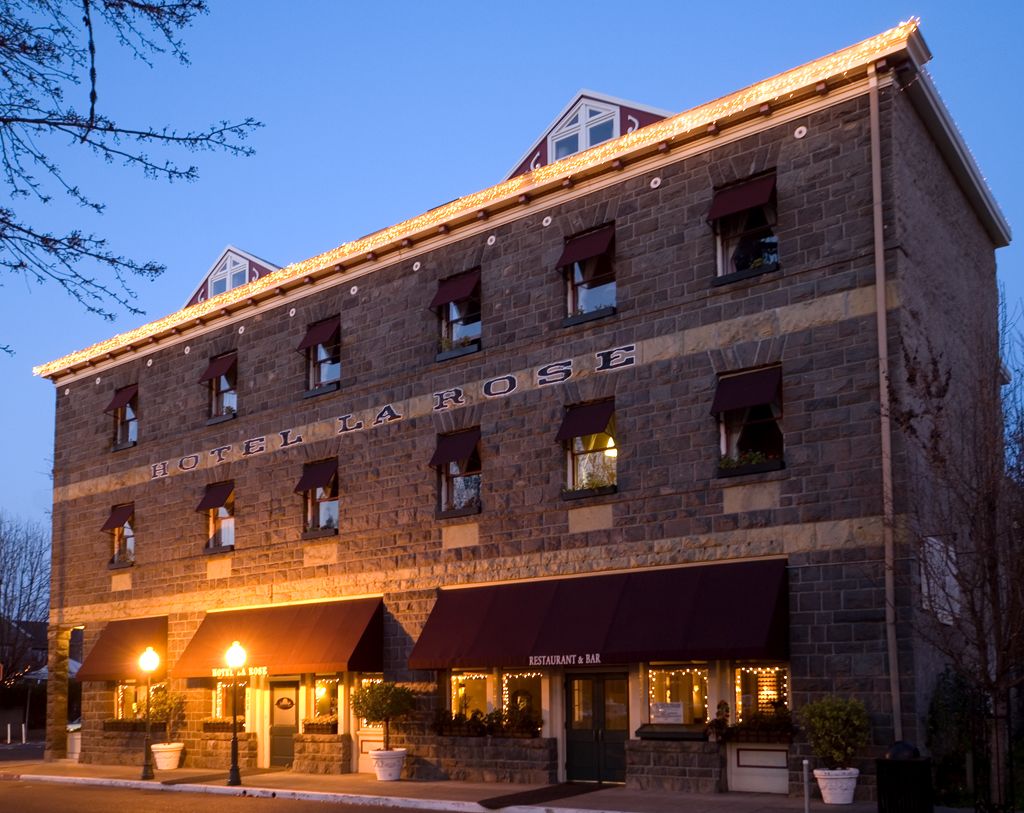
Hotel La Rose is seen in the film. A great looking historic hotel. Our friends who helped pass the nomination of the Homer Delawie home in Coronado to the National Register stayed here. A perfect choice!
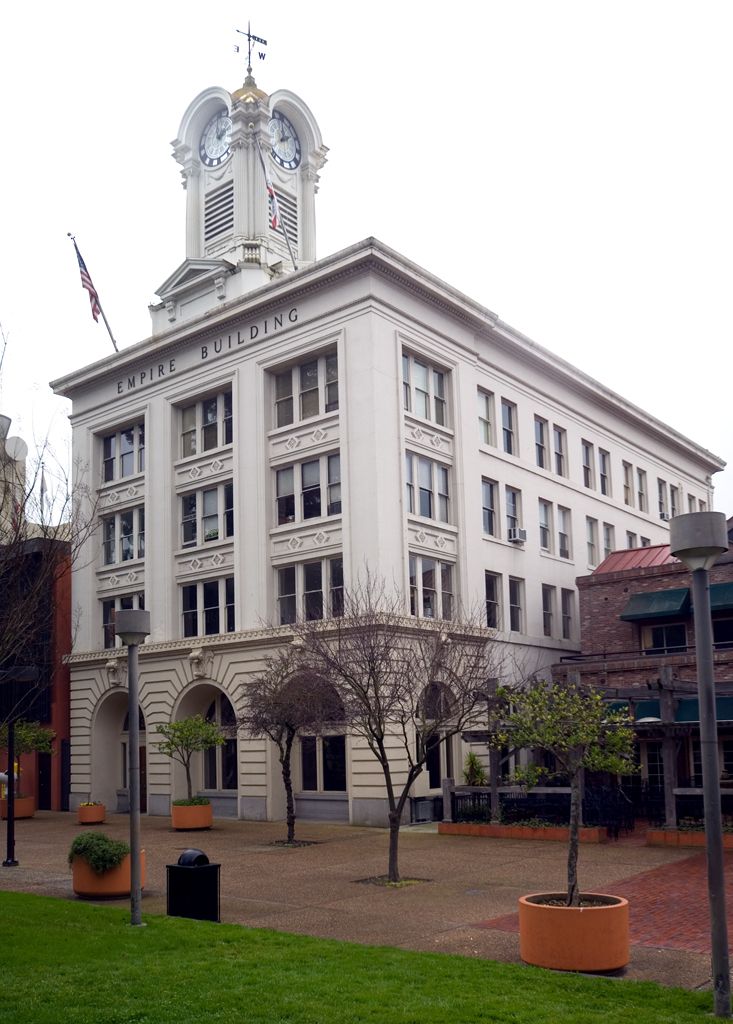
The Empire Building in Old Courthouse Square is also in the film. It was built in the aftermath of the 1906 San Francisco earthquake and completed in 1910.
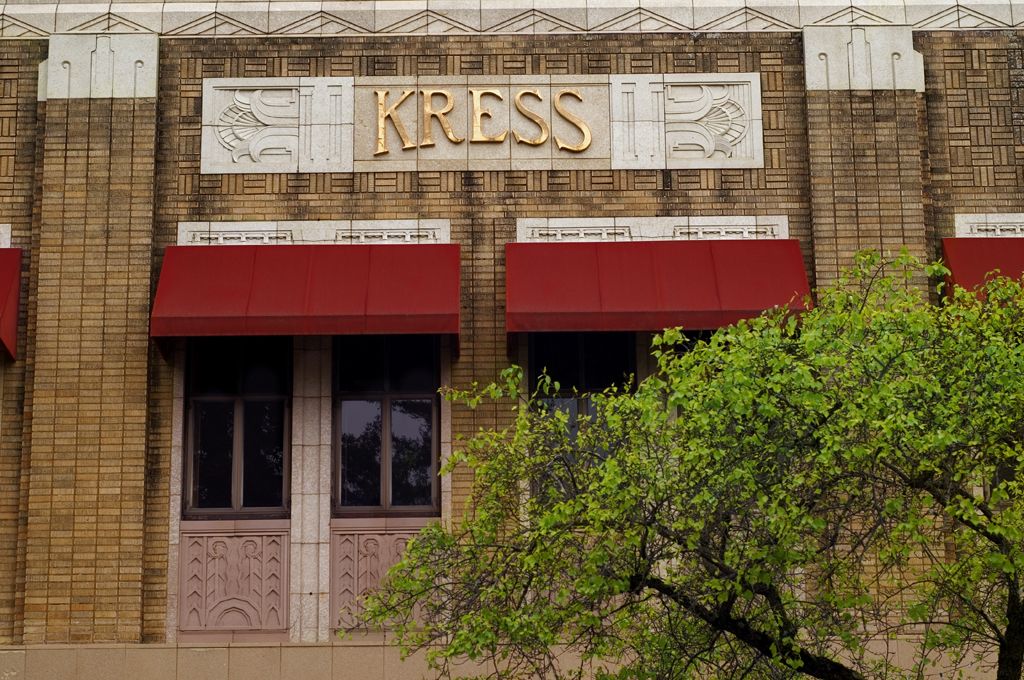
There’s a glimpse of the old Kress in the film. Shadow of a Doubt was Alfred Hitchcock’s first full American production.
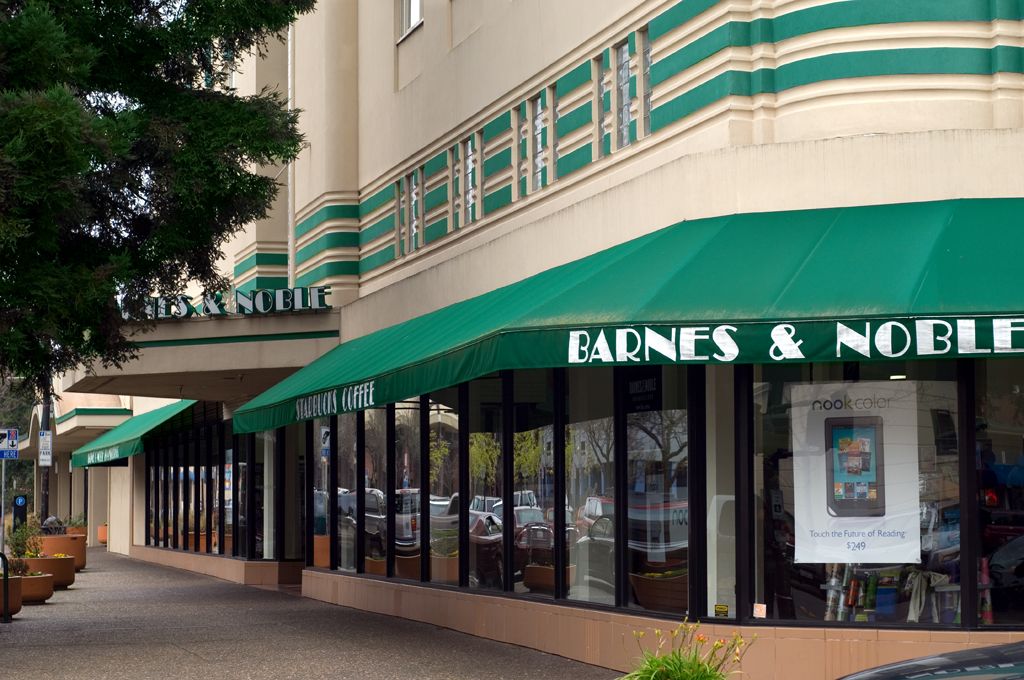
It sat vacant for years and it took dedicated effort by the community to save this 1937 Art Moderne jewel. It underwent a structural and architectural rehabilitation with a complete restoration of the exterior facade. Originally Rosenberg’s Department store, it is occupied today by Barnes and Nobel and Starbucks. Local businesses occupy the upper floors.
Another example of historic rehabilitation and restoration playing a key role in the revitalization of a downtown area.
Much of what was seen in Alfred Hitchcock’s Shadow of a Doubt no longer exists. But through some luck and preservation efforts, a sample of that time does remain.
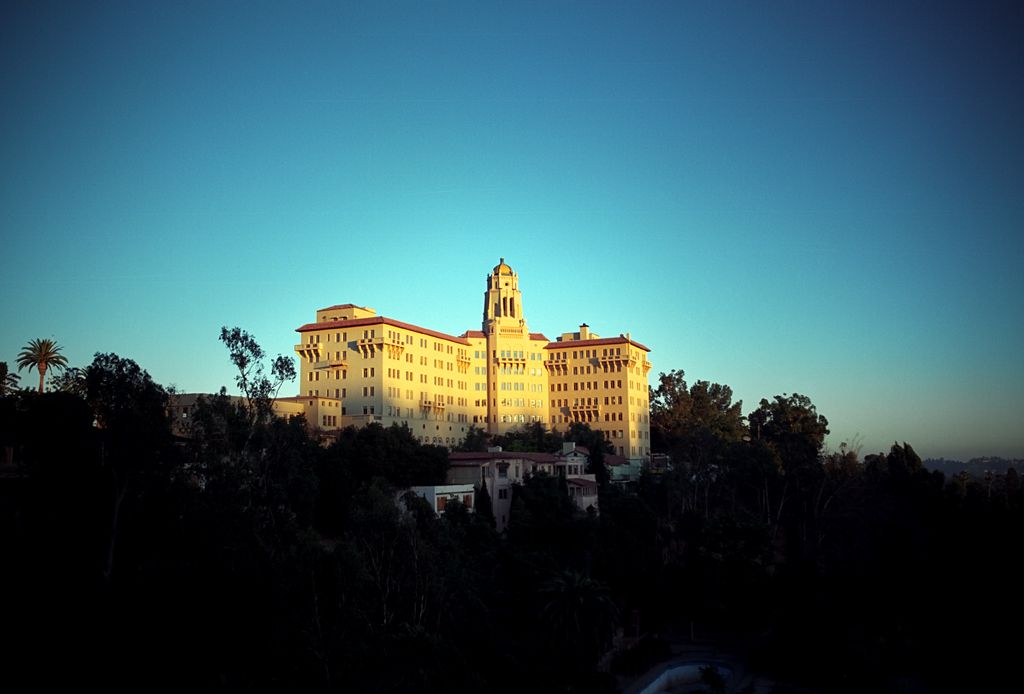
The history of La Vista del Arroyo Hotel dates back to 1882 when it was a two-story, wood-frame building, and series of small cottages.
In 1919, hotel tycoon Daniel M. Linnard, associated with such elegant Pasadena hotels as the Huntington and Green, purchased La Vista del Arroyo with the vision of developing the property into an opulent resort. Linnard commissioned the noted architectural firm of Marston & Van Pelt to design a large, two-story Spanish Colonial Revival hotel to replace the original structure. Once the popularity of the Vista had been established, select guests also built bungalows on the property.
In 1926, Linnard sold the resort to former business partner H.O. Comstock. Comstock hired architect George H. Wiemeyer to redesign the hotel and add a grand six-story addition that consisted of a central bell tower and flanking wings set at an angle. The new Vista opened in 1931 with iridescent color, entertainment, and social gaiety. In 1936, Linnard repurchased the property and hired landscape architect Verner S. Anderson to improve the hotel’s grounds by designing formal gardens and adding fountains, tennis courts, and a swimming pool.
In 1943 the U.S. War Department acquired the hotel complex and converted it into the McCormack Army Hospital and offices for the U.S. Army. In 1949, the hospital was deactivated and the old hotel, under the care of the U.S. General Services Administration (GSA), housed a variety of Federal agencies from 1951 to 1974.
In 1981 the Vista del Arroyo was placed in the National Register of Historic Places and GSA began design work to restore the building as the southern seat of the Ninth Circuit Court of Appeals. In 1995, the building was renamed to honor Judge Richard H. Chambers, whose concept it was to bring a Federal courthouse to Pasadena.
 Architecture